Arch Diary: A Serif Font That Speaks Emotion
Typography isn’t just about legibility—it’s about resonance. When you choose a font, you’re not only selecting letters; you’re inviting a mood, a rhythm, a quiet conversation with the reader. Arch Diary stands apart in this space—not as a workhorse utility font, but as a deliberate, expressive voice. It’s a unique serif typeface built for moments that demand nuance: handwritten journal entries, intimate brand storytelling, poetic book covers, or editorial layouts where tone matters as much as text.
More Than Just Curves—A Personality in Type
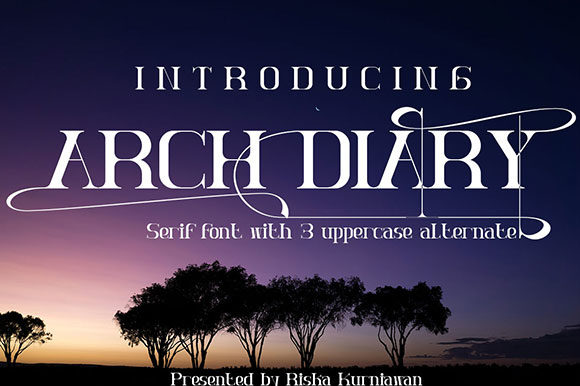
What makes Arch Diary instantly recognizable is its confident contrast: thick, generous curves balanced against delicate, hairline-thin strokes. This isn’t high-contrast like Didot or Bodoni—where drama comes from extreme polarity—but something warmer, more human. The curves feel intentional, almost tactile, like ink pressed slightly deeper into paper at key turning points. The thin lines don’t vanish; they breathe, lending elegance without fragility.
This duality gives Arch Diary a rare ability: it carries emotional weight without sacrificing clarity. You can set a line like *“I remember how the light fell across her shoulders”* in Arch Diary, and the type doesn’t shout—it leans in. It supports vulnerability, sincerity, reflection. That’s why designers working on memoirs, wellness brands, artisanal packaging, or even luxury skincare labels often reach for it when they need typography to echo intention, not just inform.
Three Alternates—Subtle Shifts, Significant Impact
One of the quiet strengths of Arch Diary lies in its thoughtful expansion: three carefully crafted alternates. These aren’t decorative flourishes—they’re functional refinements, each offering a distinct flavor while preserving typographic harmony.
- Alternate A softens terminals and adds gentle swelling to ascenders—ideal for warm, approachable applications like lifestyle blogs or greeting cards.
- Alternate B sharpens certain serifs and tightens spacing just enough to elevate formality—perfect for engraved invitations, boutique stationery, or premium product labels.
- Alternate C introduces subtle calligraphic inflections in lowercase ‘a’, ‘g’, and ‘y’, adding movement and organic flow—especially effective in editorial headlines or hand-lettered quotes.
You don’t need to swap fonts to shift tone. With OpenType support, these alternates activate seamlessly in design apps like Adobe Illustrator, InDesign, or Affinity Publisher—often via the Glyphs panel or contextual alternates toggle. Try pairing Alternate B for a headline with the default set for body copy: the result feels curated, not cluttered.
Where Arch Diary Fits in Real Design Workflows
Unlike display fonts meant solely for posters or logos, Arch Diary bridges expression and usability. Its x-height is generous, its letterforms open—so it remains highly readable at sizes as small as 14–16pt in print or 18–20px on screen. That means it works beyond hero banners: think pull quotes in long-form articles, chapter openers in indie-published novels, or even subtle UI elements in meditation or journaling apps where calm typography reinforces experience.
In branding, Arch Diary shines when paired intentionally. Try it with a clean, neutral sans-serif (like Inter, Lato, or Poppins) for contrast that feels respectful—not oppositional. The serif brings warmth and identity; the sans grounds it in modern clarity. A coffee roaster might use Arch Diary for their origin story on the bag, then switch to a crisp sans for roast profiles and tasting notes. The hierarchy feels natural, not forced.
For web use, Arch Diary performs well with variable font options (if available) or standard WOFF2 hosting. Just be mindful of loading strategy: because its character set includes stylistic alternates and ligatures, embedding the full family adds minimal overhead—but prioritize critical subsets (Latin + basic punctuation) for faster initial render. Most users won’t notice the difference between “full” and “optimized”—but they’ll feel the cohesion.
Why Designers Choose Arch Diary—And When They Pause
Designers reach for Arch Diary when they want to avoid cliché. It’s not another revival of Garamond or a trendy slab. It’s contemporary, yet timeless. It suggests craft without pretension. Clients respond to it instinctively—especially in emotionally driven sectors: therapy practices, wedding planners, independent authors, ceramic studios, slow-fashion labels.
But it’s not universal—and that’s by design. Arch Diary isn’t ideal for dense technical documentation, data dashboards, or interfaces requiring rapid scanning. Its expressive nature asks for breathing room. If your project needs neutrality, speed, or strict accessibility compliance at ultra-small sizes, a more utilitarian serif (like Merriweather or Source Serif) may serve better.
Also worth noting: licensing. Arch Diary is typically offered as a commercial font, often with clear desktop, web, and app usage terms. Always verify the license scope before deploying—especially for SaaS products or client projects where redistribution is involved. Many foundries offer trial versions, so test it in your actual layout before committing.
Pairing Arch Diary Thoughtfully
Great pairings don’t compete—they converse. With Arch Diary, contrast is kinder than similarity. Avoid other high-contrast serifs (like Playfair Display), which risk visual tension. Instead, consider:
- A geometric sans—think Montserrat or Neuzeit Grotesk—for clean, grounded balance.
- A humanist sans—like Nunito or Noto Sans—for softer, friendlier contrast.
- A monospaced companion—such as IBM Plex Mono—for code snippets, timestamps, or minimalist captions that anchor the emotion with structure.
Color matters, too. Arch Diary’s thick curves hold up beautifully in deep charcoals, forest greens, or muted terracottas—but can feel heavy in pure black on white for large blocks. Try rich navy (#2C3E50) or warm charcoal (#34495E) instead. For digital use, ensure sufficient contrast ratio (at least 4.5:1) against backgrounds—its thin strokes remain legible, but only if luminance is considered.
Real Projects, Real Results
A recent example: a mental health podcast rebranded using Arch Diary for episode titles and guest quotes. The font softened the clinical associations often tied to psychology visuals—replacing sterility with sincerity. Listeners reported feeling “seen” before even pressing play.
Another: a small-batch candle maker used Alternate C for scent descriptions (“smoke and dried lavender”) on matte black labels. The slight calligraphic lift made ingredients feel hand-chosen, not mass-formulated. Sales increased 22% post-relaunch—customers cited “the way it felt to read the words” as a key reason they connected.
Even in motion, Arch Diary holds presence. Animated slowly—letter-by-letter, with staggered opacity—the thick curves create satisfying visual rhythm. It’s become a favorite for Instagram Reels intros and short documentary title sequences where narrative intimacy is non-negotiable.
Getting Started—Simple, Not Simplistic
You don’t need advanced typographic training to use Arch Diary well. Start small: replace one heading in an existing layout. Toggle between alternates. Adjust tracking—slight loosening (10–20 units) often enhances its airy elegance. Avoid all-caps unless stylized deliberately; its personality lives in lowercase subtlety.
If you’re new to expressive typography, treat Arch Diary like a collaborator—not a tool. Ask it questions: *Does this headline feel honest? Does this paragraph invite pause? Does this color make the curves sing or strain?* Trust your eye. And when in doubt, step back. Arch Diary rewards restraint. Let it breathe. Let it mean something.