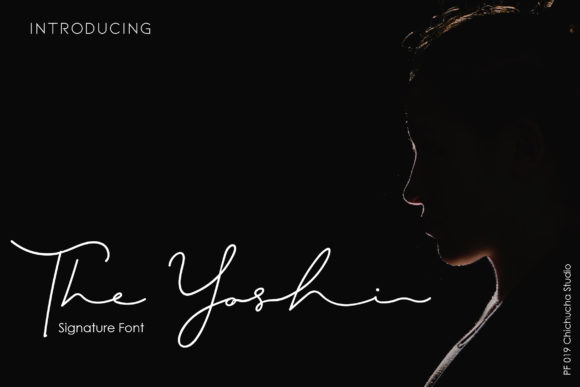
The Yoshi
Typography choices shape first impressions more than many designers admit—especially in branding, editorial work, and digital publishing. The Yoshi stands out not because it shouts, but because it carries quiet authority. It’s a signature serif font designed with intention: refined proportions, subtle contrast, and a rhythm that feels both contemporary and timeless. Unlike display fonts built for novelty, The Yoshi was crafted to serve—reliably, gracefully, and without distraction.
A Font Built for Clarity and Character
At its core, The Yoshi is a high-contrast serif with gently flared terminals, modest bracketing, and open apertures. Its x-height sits comfortably between traditional text faces and modern editorial serifs—neither too compact nor too generous—making it legible at small sizes while retaining presence in headlines. The italics aren’t slanted versions of the roman; they’re true cursive interpretations, with fluid entry and exit strokes that support reading flow rather than interrupt it.
What sets The Yoshi apart from similar fonts isn’t just aesthetics—it’s consistency across weights and widths. The family includes six weights (Thin through Black), each with matching italics, plus a condensed variant. Kerning pairs are thoroughly tested—not just for common letter combinations, but for real-world usage: acronyms, product names, multi-word headlines, and stacked navigation labels. That attention shows in practice: a business card set in The Yoshi Bold reads cleanly at 8 pt, and a blog headline at 48 pt doesn’t feel heavy or unbalanced.
Where The Yoshi Delivers Practical Value
Designers often reach for a new font hoping it’ll “elevate” their work—only to find it undermines readability or clashes with existing UI components. The Yoshi avoids that pitfall by prioritizing functional harmony. It works well in mixed-font environments: paired with a neutral sans-serif like Inter or Manrope for body copy, The Yoshi adds distinction to headings without competing for attention. In long-form editorial layouts—think newsletters, white papers, or course modules—it sustains visual interest over paragraphs without fatiguing the eye.
Its performance in digital contexts is notably strong. Hinting is optimized for screen rendering, and variable font support (where available) allows fine-tuned optical sizing—smaller instances gain slightly increased stroke weight and spacing, larger ones retain elegance without thinning out. This matters for responsive design: a testimonial quote styled with The Yoshi Medium on desktop remains legible and tonally consistent when scaled down for mobile.
Real-World Use Cases and Audience Fit
The Yoshi suits professionals who need typographic distinction without sacrificing usability. Consider these examples:
- Small business owners launching a premium service—say, a boutique financial advisory firm—can use The Yoshi SemiBold for their logo and website headers. It conveys competence and discretion, avoiding the coldness of ultra-minimalist sans-serifs or the dated formality of traditional book fonts.
- Educators and course creators building online learning materials benefit from its clear hierarchy. A syllabus using The Yoshi Light for section titles and The Yoshi Regular for learning objectives maintains academic credibility while feeling approachable.
- Bloggers and independent publishers aiming for a distinctive yet professional voice often struggle to balance personality and polish. The Yoshi supports that balance: its italic lends warmth to pull quotes, and its bold weight anchors featured content without overwhelming adjacent text.
- Freelance designers managing multiple client projects appreciate its adaptability. One license covers web, desktop, and app use—no need to juggle separate webfont subscriptions or worry about embedding restrictions during handoff.
Quality and Long-Term Usability Considerations
Font quality extends beyond glyph design—it includes language support, OpenType features, and technical reliability. The Yoshi covers Latin Extended-A, supporting Western, Central, and parts of Eastern European languages. It includes standard ligatures, discretionary ligatures (for stylistic refinement in headlines), small caps, and old-style figures—features that matter when crafting polished PDF reports or print-ready brochures.
That said, it’s not a universal solution. The Yoshi lacks Cyrillic, Greek, or Vietnamese support, limiting its use in multilingual global campaigns. Its high contrast makes it less suitable for low-resolution print or very small UI labels (e.g., 9-pt interface text). And while its condensed variant helps in tight spaces, it shouldn’t replace dedicated monospaced or ultra-narrow fonts for data-dense tables or code annotations.
Also worth noting: The Yoshi performs best when given room to breathe. Tight tracking or aggressive letter-spacing can undermine its natural rhythm. Designers accustomed to forcing fonts into narrow containers may need to adjust layout expectations—allowing slightly more line height or margin space yields better results than compressing the type itself.
Integrating The Yoshi Into Your Workflow
If you’re evaluating whether The Yoshi fits your current or upcoming projects, start small. Try it in one controlled context: a landing page headline, a branded email subject line, or a single slide in a presentation deck. Observe how it interacts with your existing color palette and imagery. Does it enhance tone—or compete with it? Does it clarify hierarchy, or blur distinctions between sections?
For teams, consider licensing early. The desktop + web bundle simplifies deployment across Figma files, WordPress themes, and marketing platforms. Most users report minimal setup friction—webfont loading is fast, and variable axis controls (if used) integrate smoothly with CSS @font-face declarations.
One practical tip: avoid overusing the Black weight. Its impact is strongest when contrasted against lighter weights—not as default body or navigation text. Reserve it for moments where emphasis truly matters: a key value proposition, a call-to-action button, or a chapter opener in an ebook.
Final Thoughts for Purposeful Typography Choices
Good typography doesn’t draw attention to itself—it directs attention where it belongs: to the message, the brand, the idea. The Yoshi succeeds by operating with restraint and precision. It’s not flashy, but it’s dependable. Not experimental, but quietly confident. Its strength lies in how consistently it supports intent—whether that’s conveying trust in a B2B SaaS dashboard, evoking craftsmanship in a ceramicist’s portfolio, or lending gravitas to a nonprofit’s annual report.
That reliability makes it especially valuable for professionals who don’t have time to troubleshoot inconsistent rendering, limited language coverage, or mismatched weights across platforms. If your work involves communicating with clarity and intention—and if you’ve found yourself cycling through fonts that look great in isolation but falter in context—The Yoshi is worth testing with genuine, project-specific criteria in mind. Not as a trend, but as a tool calibrated for sustained, thoughtful use.