Abdullah: Handwritten Charm, Done Right
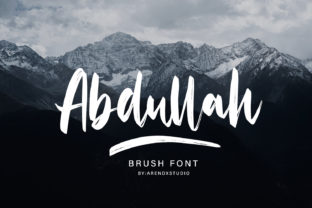
If you’ve ever scrolled past a logo, social post, or book cover and paused—just for a second—because the lettering felt warm, intentional, and unmistakably human, there’s a good chance Abdullah was behind it. This isn’t just another script font slapped together from vector curves and algorithmic flourishes. Abdullah is built from real handwriting: distinct, slightly uneven, full of quiet confidence. Each character carries subtle pressure shifts, natural entry and exit strokes, and gentle variations in slant and spacing—like ink laid down by hand, not generated by code.
A Script Font That Doesn’t Try Too Hard
What sets Abdullah apart isn’t perfection—it’s personality. Unlike many modern script fonts that chase uniformity or exaggerated swashes, Abdullah leans into restraint. Its lowercase a has a soft, open bowl; the g features a modest, looping tail; capitals sit comfortably upright, never shouting. There are no forced ligatures or over-engineered alternates—just one cohesive, flowing style that reads as both contemporary and timeless. It feels like something a skilled calligrapher might write for a small-batch candle label or a boutique café menu—not a corporate rebrand, but a thoughtful human gesture.
This organic vibe makes Abdullah especially effective where authenticity matters most: artisanal packaging, indie publishing, wedding stationery, personal blogs, and creator-led brands. It’s a premium font with quiet authority—not flashy, but memorable. Think of it less as a decorative flourish and more as a voice: calm, grounded, and quietly confident.
Where Abdullah Earns Its Place
Abdullah shines brightest as a display font, not body text. You’ll rarely want it at 12pt on a webpage—but at 36pt on a book spine, 48pt above a product photo, or scaled across a tote bag? That’s where its rhythm and warmth take hold. Designers use it for:
- Logo design—especially for lifestyle, wellness, food, and creative services where approachability and craft matter;
- Editorial design—chapter headings, pull quotes, or masthead treatments in independent magazines;
- Packaging design—jar labels, tea boxes, soap tags—where tactile feel translates visually;
- Social media graphics—Instagram story headers, Pinterest quote cards, or YouTube thumbnail accents;
- Print collateral—invitations, greeting cards, limited-run posters, or zine covers.
It’s less suited for dense UI interfaces, legal disclaimers, or multilingual websites requiring extensive diacritic support—but that’s not a limitation. It’s clarity of purpose. Abdullah knows its role: to invite, not inform. To suggest, not instruct.
How It Shapes Perception—Without Saying a Word
Typefaces shape how people feel before they read a single word. With Abdullah, that feeling is often “thoughtful,” “handmade,” or “intentionally small-scale.” That impression directly influences brand perception—especially for solopreneurs and micro-businesses competing against polished, faceless competitors. A bakery using Abdullah on its chalkboard sign doesn’t just list items; it signals care in sourcing, time spent kneading dough, attention to detail. That’s not marketing spin—it’s visual shorthand rooted in modern typography psychology.
Readability remains strong at display sizes because Abdullah avoids extreme contrast or tight spacing. Letters breathe. Baselines stay consistent. The x-height is generous enough to sustain legibility even when printed on textured paper or rendered at lower resolutions. And because it’s a single-style script font, it supports consistency without demanding complex hierarchy management—no need to juggle multiple weights or optical sizes. What you see is what you use, and it works.
Practical Tips Before You Install
Before adding Abdullah to your design assets, ask yourself three things:
- Does this project benefit from warmth over neutrality? If your brand voice is technical, institutional, or ultra-minimalist, Abdullah may clash—not enhance.
- What’s the primary size and medium? Test it at actual usage scale: 24pt on mobile, 60pt on a banner, 14pt on uncoated stock. Rendering varies—and Abdullah’s charm lives in its texture, which can fade if over-compressed or poorly hinted.
- How will it pair? Abdullah pairs beautifully with clean, humanist sans serif fonts (think Inter, Poppins, or Lato) and understated serif fonts (such as Crimson Text or Literata). Avoid other scripts or highly decorative faces—they compete rather than complement. A simple pairing like Abdullah + Inter creates instant balance: one voice expressive, the other functional.
Also check the included styles. Most Abdullah licenses include standard OTF/TTF files, basic OpenType features (like contextual alternates), and sometimes web-optimized WOFF2 versions. No variable axis or bold/italic variants—so don’t expect to set a paragraph in “Abdullah Bold.” It’s intentionally singular. That focus is part of its strength.
Licensing, Real Talk
Abdullah is a commercial font, meaning it requires a license for any public-facing use—even if you’re a solo blogger monetizing via affiliate links or a craftsperson selling handmade goods online. Free downloads from unofficial sites often lack proper encoding, updates, or legal coverage. Reputable sources provide clear terms: desktop, web, app, and e-book licenses are usually sold separately. If you’re building a client website, confirm whether the web license covers dynamic text (e.g., user-generated headlines) or just static headings.
And yes—it’s worth it. Not because it’s expensive, but because it’s reliable, well-hinted, and backed by responsive foundry support. When a font renders cleanly across Chrome, Safari, and iOS Mail—and holds up in print proofs—that’s professional infrastructure you can’t fake with a free alternative.
Abdullah won’t solve every design problem. But when you need a voice that feels human in a crowded digital feed, or a touch of craft in an increasingly automated world—it’s one of the few handwritten fonts that delivers without apology. It doesn’t shout. It doesn’t trend-hop. It simply shows up—distinct, natural, and quietly unforgettable.