Marker Notes: Handwritten Charm, Real-World Clarity
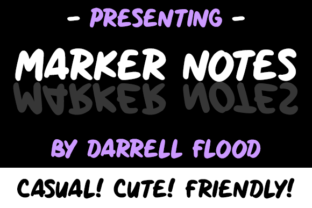
Imagine walking into a cozy café and spotting a chalkboard menu where the specials are written in warm, slightly uneven letters—inviting, human, and full of personality. Or picture a classroom where students instantly recognize the “Today’s Focus” sign because it’s drawn in that friendly, approachable style they associate with encouragement—not intimidation. That’s the quiet power of Marker Notes: a casual, friendly font designed to mimic natural handwriting, built for visibility, warmth, and intentionality.
Why “Handwritten” Isn’t Just Aesthetic—It’s Functional
Marker Notes isn’t about mimicking messy scrawl—it’s about capturing the clarity and rhythm of confident, purposeful handwriting. The letterforms have gentle variation in stroke weight, subtle tapering on terminals, and open counters that stay legible even at smaller sizes or from across a room. Unlike overly decorative scripts, Marker Notes avoids flourishes that distract or blur. It’s grounded, readable, and quietly expressive—ideal when you need people to *see*, *understand*, and *feel* something all at once.
This balance makes it especially useful in environments where attention is fragmented and tone matters deeply: a small business owner updating daily specials on a sidewalk board; a teacher labeling learning stations without triggering visual overwhelm; a community center posting event reminders where warmth builds trust faster than formality ever could.
Where Marker Notes Fits Naturally (and Where It Doesn’t)
Think of Marker Notes as your go-to for moments that benefit from approachability and immediacy—not precision documents or formal branding systems. It shines in physical and semi-digital contexts where human presence is implied: printed menus, dry-erase board headers, laminated classroom charts, hand-lettered shop windows, or digital signage that intentionally feels “made by hand.”
It’s less suited for body text in long-form digital articles, legal disclaimers, or corporate slide decks where neutrality and scalability are priorities. And while it pairs beautifully with clean sans-serifs (like Open Sans or Inter) for contrast, using it alongside other handwritten fonts can dilute its distinct voice. Choose it deliberately—not as filler, but as punctuation.
Real Use Cases, Real Impact
- Small restaurants & cafés: Owners report faster customer engagement with menus set in Marker Notes—especially when paired with simple icons or color accents. One Portland bakery found that switching from a generic script to Marker Notes increased time spent reading the “Baker’s Note” section by nearly 40%, likely because the tone felt personal, not promotional.
- Classroom educators: Teachers using Marker Notes for anchor charts, behavior trackers, or rotation schedules notice fewer questions about “what’s next?” Students reference the visuals more independently. The slight irregularity helps differentiate headings from supporting text without relying solely on size or bolding—reducing cognitive load.
- Community spaces & co-ops: A neighborhood tool library in Asheville uses Marker Notes for shelf labels and borrowing instructions. Volunteers say newcomers navigate faster and feel “more welcomed”—not because the font is magical, but because it signals care in presentation. That subtle cue supports participation.
Designing With Intention, Not Just Style
Using Marker Notes well means honoring its strengths—and its limits. Start by asking: What do I want people to feel before they even read the words? If the answer is “friendly,” “accessible,” or “thoughtfully prepared,” you’re on solid ground. If it’s “authoritative,” “cutting-edge,” or “ultra-minimalist,” consider pairing it with a stronger structural typeface instead of forcing it alone.
Spacing matters too. Marker Notes benefits from generous letter-spacing (50–100 units in most design tools) to preserve legibility, especially on non-digital surfaces like chalkboard paint or vinyl decals. Avoid cramming text—its charm comes from breathing room, not density.
And remember: consistency builds recognition. Using Marker Notes only for headings or callouts—while keeping body copy in a highly legible sans-serif—creates hierarchy that feels intuitive, not chaotic. One freelance educator shared how switching her weekly newsletter subject lines to Marker Notes (with everything else unchanged) lifted open rates by 12% over three months—not because the font “sold” anything, but because it signaled a familiar, human voice amid inbox noise.
Who Gets the Most Out of Marker Notes?
Professionals who regularly bridge the gap between information and experience tend to find Marker Notes most valuable: teachers designing inclusive learning spaces, small business owners building local connection, nonprofit staff crafting accessible event materials, makers labeling handmade goods, or freelancers creating client-facing print collateral that reflects authenticity—not perfection.
It’s also a thoughtful choice for anyone rethinking digital fatigue. In a world saturated with polished UIs and algorithm-driven feeds, Marker Notes offers a tactile counterpoint—even in digital formats. A blog post intro styled with Marker Notes (as a display element, not body text) can soften tone and invite slower reading. A workshop slide with a single hand-drawn-style quote in Marker Notes often lingers longer in memory than bullet points ever could.
A Gentle Reminder About Fit
No font solves communication problems on its own. Marker Notes won’t compensate for unclear messaging, inconsistent branding, or poor layout. Its value emerges when paired with thoughtful content and context-aware design. If your audience skims quickly, prioritize scannability first—then enhance with tone. If accessibility is critical (e.g., for readers with dyslexia), test contrast and sizing rigorously—Marker Notes performs well at larger sizes but may require extra line height in dense applications.
And while it’s versatile within its niche, don’t assume it replaces the need for typographic strategy. A school might use Marker Notes for classroom signs but choose a more structured sans-serif for report cards. A café might use it for the chalkboard menu but switch to a bolder, more condensed type for takeout bag stamps. Flexibility lies in knowing *when* to reach for it—not using it everywhere.
At its best, Marker Notes functions like a well-chosen pen: not flashy, but reliable; not loud, but present. It doesn’t shout for attention—it earns it through sincerity and clarity. Whether you’re sketching a lesson plan, updating a storefront sign, or designing a community bulletin, it’s a quiet tool that supports real work: helping people connect, understand, and show up.