Lovea Script: A Cheerful, Modern Calligraphy Font for Real-World Design
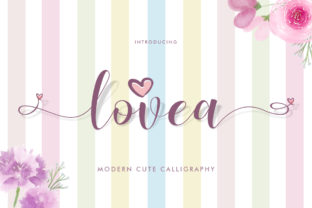
Lovea Script stands out in the crowded landscape of script fonts—not because it’s the most ornate or technically precise, but because it delivers consistent warmth and approachability without sacrificing legibility or versatility. Designed with a relaxed hand-drawn rhythm, Lovea Script is a modern calligraphy font that balances personality with practicality. It doesn’t try to mimic traditional copperplate or formal brush lettering; instead, it embraces subtle bounce, gentle contrast, and open letterforms that feel intentionally human—not rushed, not over-polished, and never stiff.
What Makes Lovea Script Distinctive—Beyond the “Fun” Label
The descriptor “fun” often gets applied loosely to playful typefaces, but with Lovea Script, that quality emerges from structural choices—not just stylistic flourishes. Its lowercase a, g, and y feature soft, rounded terminals rather than sharp angles or exaggerated swashes. The x-height is generous, supporting readability at smaller sizes, while the moderate stroke contrast (thicker downstrokes, lighter upstrokes) gives rhythm without visual noise. Importantly, Lovea Script includes full Latin character sets, standard punctuation, numerals, and basic OpenType features like ligatures and contextual alternates—enough to support professional use without requiring manual tweaking for common word combinations.
Unlike many trendy scripts that rely heavily on discretionary swashes or alternate glyphs to appear dynamic, Lovea Script achieves visual interest through consistency. Every character flows naturally into the next, and spacing has been carefully tuned—not too tight, not too loose—so words read smoothly even in short headlines or social media graphics. That reliability matters when you’re designing across platforms: a logo lockup in Lovea Script holds up equally well on a business card, an Instagram story, or a printed workshop handout.
Where Lovea Script Performs Best—And Where It Doesn’t Try To
Lovea Script excels in contexts where tone and approachability matter more than formality. Think welcome banners for online courses, packaging labels for small-batch food brands, email headers for wellness newsletters, or book covers for memoirs and lifestyle titles. Its warmth helps soften corporate messaging—use it for a “Thank You” section in a SaaS onboarding flow, and it feels personal without seeming unprofessional.
It’s less suited for long-form body text, legal disclaimers, or environments demanding high information density. Like most script fonts, Lovea Script isn’t built for paragraphs—it’s a voice, not a narrator. Similarly, pairing it with overly geometric or rigid sans-serifs (like Helvetica Neue or Montserrat Bold) can create tonal whiplash. Better pairings include friendly, humanist sans-serifs—think Nunito, Poppins, or even a softened version of Inter—with enough warmth and open counters to echo Lovea Script’s energy without competing.
Usability in Practice: Workflow, Compatibility, and Output Quality
Lovea Script is available in both OTF and TTF formats and works reliably across major design tools—including Adobe Creative Cloud apps, Figma, Affinity Designer, and Canva (when uploaded as a custom font). Kerning pairs are well-adjusted out of the box, reducing the need for manual spacing corrections in headline use. In testing across print and digital outputs, characters retain clarity at sizes as small as 18 pt for display headings and remain crisp up to 200 pt for large-format signage.
One practical strength is its weight consistency. Unlike some variable scripts that shift dramatically between light and bold variants, Lovea Script maintains its core rhythm and proportion across weights—regular, bold, and sometimes italic (depending on the foundry release). This makes it easier to establish visual hierarchy without disrupting tone. For example, using Lovea Script Bold for a product name and Lovea Script Regular for a tagline keeps cohesion intact, whereas switching to a completely different family would require additional brand rationale.
No font is immune to rendering quirks, and Lovea Script does show minor inconsistencies in certain web environments—particularly older versions of Safari or when embedded via @font-face without proper subsetting. For web use, it’s advisable to serve it as a self-hosted font with fallbacks (e.g., font-family: "Lovea Script", cursive;) and test across devices. It performs best as a display font loaded selectively—not as a site-wide default.
Who Benefits Most—and Why Timing Matters
Entrepreneurs launching direct-to-consumer brands often face a narrow window to communicate authenticity and care before users scroll away. Lovea Script supports that goal efficiently: it signals craft and attention without demanding illustration-level customization. A ceramicist listing on Etsy can use it for shop banner text and product titles—immediately reinforcing handmade ethos. A freelance educator building a course on mindful communication might choose Lovea Script for slide headers and workbook chapter titles, subtly reinforcing calm intentionality.
Bloggers and content creators targeting audiences aged 25–45—especially in wellness, education, parenting, or creative entrepreneurship—find Lovea Script resonates well with readers who respond to sincerity over polish. Its lack of pretense helps avoid alienating readers who associate ultra-refined scripts with exclusivity or outdated aesthetics. Small business owners updating their brand identity without a full rebrand can integrate Lovea Script incrementally: first in email signatures, then in social bios, then in new marketing assets—testing reception before committing to broader usage.
Realistic Considerations Before Committing
Lovea Script isn’t a universal solution—and that’s part of its value. It won’t solve weak messaging, poor color choices, or inconsistent layout. Its effectiveness depends on thoughtful application, not just installation. If your audience expects authority and gravitas—think financial advisors, B2B enterprise software, or academic publishers—Lovea Script may undercut intended credibility unless balanced carefully (e.g., used only for secondary elements like quote callouts or section dividers).
Licensing is another practical factor. Lovea Script is typically offered under commercial licenses, but terms vary by vendor. Some versions allow unlimited use across client projects; others restrict redistribution or require separate licensing per domain or app. Always verify permissions before embedding in client deliverables or white-labeled products. And while it supports Western European languages well, extended Cyrillic, Greek, or Arabic support is generally not included—so global multilingual sites will need complementary typefaces.
Final Thoughts: A Tool With Clear Intent
Lovea Script succeeds because it knows its role. It’s not trying to be everything—a workhorse text face, a dramatic display monolith, or a novelty font for one-off memes. Instead, it fills a specific, recurring need: communicating friendliness, care, and quiet confidence in visual language. When used with intention—paired thoughtfully, sized appropriately, and deployed where tone matters most—it adds measurable warmth to user touchpoints without requiring extra design labor.
For professionals balancing speed, brand alignment, and emotional resonance, Lovea Script offers a rare combination: ease of integration, consistency across outputs, and a distinctive voice that doesn’t shout. It won’t replace your primary sans-serif or serif system—but as a considered accent, it earns its place in the toolkit.