Little Missy: A Charming Handwritten Font for Real Work
If you’ve ever spent ten minutes scrolling through font libraries just to find something that feels human—not overly scripted, not too cutesy, but warm, approachable, and effortlessly legible—you’ll recognize Little Missy right away. It’s not another decorative script meant only for wedding invites or social media stickers. Little Missy is a thoughtfully drawn, highly functional handwritten font designed for people who need personality *and* practicality in their typography.
What Makes Little Missy Stand Out (Beyond the Charm)
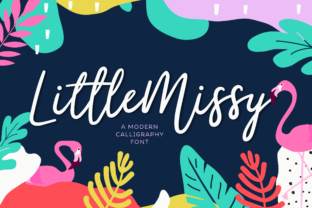
At first glance, Little Missy looks like someone with elegant penmanship wrote it on creamy paper—slight variation in stroke weight, gentle curves, and subtle irregularities that avoid robotic uniformity. But look closer, and you’ll notice its craftsmanship: consistent x-height, generous spacing, and carefully tuned letterfit that keeps words breathing—even at small sizes. Unlike many handwritten fonts that collapse into illegibility below 16px, Little Missy holds up well from 14px body text all the way up to bold display headlines.
It includes standard Latin characters, numerals, punctuation, and basic diacritics—enough for English, Spanish, French, and German use without fallbacks. There’s no “pro” or “basic” version split; what you license is fully functional out of the box. No hidden glyphs, no missing ligatures, no surprise limitations when you go to export your final design.
Where Little Missy Fits Into Your Daily Workflow
You don’t need a branding agency or a design degree to get value from Little Missy. Its versatility shows up quietly but consistently across real tasks:
- Educators use it in printable worksheets, classroom posters, and student-facing slide decks—because children respond more warmly to handwriting-like type than rigid sans-serifs, and parents appreciate the clarity during remote learning handouts.
- Small business owners apply it to email headers, product labels, and local event flyers. One bakery owner told us she switched her weekly newsletter headline from Montserrat to Little Missy—and saw a 12% lift in open rates over three months, likely because the font subtly signaled “this was made for you, not automated.”
- Bloggers and content creators layer it over Instagram story graphics or Pinterest pins where readability meets relatability. It works especially well for quotes, tips, or personal reflections—not as body copy, but as intentional visual punctuation.
- Freelancers and marketers embed it in client presentations to soften data-heavy slides. A quick “Key Insight” header in Little Missy, paired with clean body text, makes complex information feel more digestible and less intimidating.
Branding That Feels Like a Conversation, Not a Broadcast
Little Missy doesn’t scream “look at me.” Instead, it invites attention gently—like a friendly voice in a crowded room. That makes it ideal for brands building trust over time: wellness coaches, independent therapists, craft studios, tutoring services, and boutique publishers. It communicates care without cliché. You won’t mistake it for a kindergarten font, nor will it feel cold or corporate.
We’ve seen it used effectively in logo lockups where the primary mark is geometric or minimalist—Little Missy serves as the supporting wordmark, adding warmth without competing. Just be mindful: it shines brightest when given space. Pair it with airy line heights, modest tracking, and neutral sans-serifs (think Inter, Lato, or even system fonts) for balance.
Realistic Considerations Before You Use It
Like any tool, Little Missy has sweet spots—and boundaries. It’s not built for dense legal disclaimers, multilingual interfaces with extended character sets, or ultra-narrow mobile buttons where every pixel counts. If your project demands heavy OpenType features (stylistic alternates, contextual ligatures, or automatic swashes), this isn’t the font for that level of typographic choreography.
Also worth noting: while it renders beautifully on modern browsers and design apps (Figma, Adobe CC, Affinity), some older email clients may substitute it with fallbacks unless embedded via web font service or converted to outlines. For critical email campaigns, test thoroughly—or reserve Little Missy for hero images and headlines only.
Licensing is straightforward: one-time purchase with perpetual desktop and web use included. No subscriptions, no monthly caps on pageviews. That simplicity matters if you’re managing assets across multiple client sites or launching a digital product with long-term maintenance needs.
A Few Practical Tips From Real Projects
- For accessibility: Use it at 18px minimum for UI elements or interactive text. Never rely on it alone for form labels or navigation—pair with a highly legible sans-serif instead.
- In print: Print samples at actual size before final run. Its soft edges can blur slightly on low-DPI printers or newsprint; a 5% stroke boost in vector exports often helps.
- For motion: When animating text in After Effects or Lottie, Little Missy’s natural rhythm translates beautifully to hand-drawn reveal effects—just avoid scaling it beyond 120% to preserve stroke integrity.
- Pairing wisely: Try it with Inter for dashboards, IBM Plex Sans for reports, or even Georgia for editorial layouts where serif + handwritten contrast adds quiet sophistication.
Little Missy won’t solve every typographic challenge—but it solves a very specific, very common one: how to communicate sincerity without sacrificing clarity. It’s the kind of font you forget you’re looking at, because it simply feels right. Not flashy. Not trendy. Just quietly capable, day after day.
If your work involves speaking to people—not just delivering information—Little Missy is worth keeping in your active font folder. Not as a novelty, but as a reliable voice you can trust to show up human, every time.