Dinomik: A Cheerful Sans Serif Font for Creative Projects
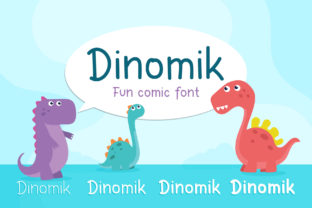
Dinomik is a playful, rounded sans serif typeface designed with warmth and approachability in mind. It features soft curves, open letterforms, and consistent stroke contrast—traits that contribute to its friendly, lighthearted character. Dinomik comes in four distinct variations: Regular, Bold, Italic, and Bold Italic. Each weight maintains visual harmony while offering enough typographic flexibility for headings, short paragraphs, or accent text in digital and print contexts.
Designers and content creators often seek fonts that reinforce tone without sacrificing legibility or versatility. Dinomik fits this need when the goal is to convey energy, youthfulness, or gentle informality—particularly in branding for children’s products, educational tools, wellness initiatives, or lifestyle-focused websites and social media graphics. Its design avoids sharp angles and rigid geometry, making it stand apart from more neutral or corporate sans serifs like Helvetica or Inter.
One reason someone might consider Dinomik is its immediate emotional resonance. Unlike fonts optimized for dense body text or high-contrast environments, Dinomik prioritizes expressive charm. This makes it especially effective at small-to-medium sizes in visual contexts where personality matters more than typographic neutrality—such as logos, app onboarding screens, presentation slides, or illustrated editorial layouts.
However, practical considerations apply. Dinomik’s rounded terminals and modest x-height mean it may not perform as well in long-form reading scenarios. For extended paragraphs—especially on low-resolution screens or in small print—it can reduce readability compared to fonts engineered for extended legibility, such as Lato, Open Sans, or Source Sans Pro. Its stylistic consistency also means less built-in typographic hierarchy; users may need to supplement with spacing, color, or layout adjustments to distinguish headings from supporting text.
Another factor is language support. Dinomik includes basic Latin characters and common punctuation, but does not extend to extended Latin (e.g., Central/Eastern European diacritics), Cyrillic, Greek, or non-Latin scripts. Projects targeting multilingual audiences—or those requiring robust internationalization—should verify coverage before committing to Dinomik as a primary font.
File size and web performance are generally favorable. As a modest family of four styles, Dinomik remains lightweight for web embedding. When self-hosted or served via a reliable font provider, loading impact is minimal—especially if only the necessary weights are loaded. Still, teams using dynamic font-loading strategies should confirm that all required variants are explicitly declared to avoid invisible text or layout shifts.
Dinomik works best when used intentionally—not as a default system font replacement, but as a deliberate typographic choice aligned with voice and audience. It shines in contexts where brand identity benefits from visual softness and approachability: think packaging for organic snacks, mobile apps for early literacy, event posters for community workshops, or Instagram story templates for creative educators. In these cases, its consistency across weights supports cohesive design systems without requiring extensive custom styling.
Conversely, alternatives may be preferable in other situations. For enterprise dashboards, technical documentation, or news sites emphasizing clarity and speed of comprehension, more neutral, highly legible sans serifs remain stronger options. Similarly, if a project demands fine-grained typographic control—such as optical sizing, variable axes, or advanced OpenType features—Dinomik’s static design offers limited flexibility compared to variable fonts like Recursive or IBM Plex Sans.
It’s also worth noting that Dinomik is not open source. Licensing terms vary depending on usage—web, desktop, app, or commercial redistribution—and require review before deployment. Designers working within larger organizations should ensure legal and procurement teams approve its use, particularly for embedded or white-labeled applications. Independent creators should confirm license scope matches intended distribution channels—for example, using Dinomik in a client’s logo versus including it in a downloadable Canva template.
When evaluating whether Dinomik aligns with your goals, begin by clarifying intent. Ask: Is the priority expressive tone or functional legibility? Who is the audience—and how much time will they spend interacting with the text? What formats will the design appear in (print, mobile, large-format signage)? If the answer emphasizes emotional connection over information density—and if the usage falls within its supported character set and licensing boundaries—Dinomik is a viable, distinctive option.
Testing is essential. Render sample text in realistic conditions: on target devices, alongside interface elements, and at expected sizes. Compare side-by-side with alternatives to assess contrast, rhythm, and hierarchy. Pay attention not just to how Dinomik looks, but how it behaves—does it maintain balance next to imagery? Does it scale predictably across breakpoints? Does it pair well with a secondary font for body copy (e.g., a more neutral sans serif or even a restrained serif for contrast)?
Finally, consider long-term maintainability. A font choice affects not just initial design but future updates, localization efforts, and cross-team collaboration. If Dinomik supports your current phase but lacks scalability for anticipated growth—say, expanding into new markets or adding complex UI components—it may make sense to adopt it selectively (e.g., for headlines only) while reserving more versatile fonts for structural text.
In summary, Dinomik serves a specific niche: cheerful, intentional typography where friendliness enhances rather than distracts from communication. It is neither a universal solution nor a purely decorative novelty. Its value emerges most clearly when matched thoughtfully to context, audience, and constraints—and when evaluated not in isolation, but as one component of a broader typographic strategy.