Banda Niera: The Friendly Sans Serif That Fits Right In
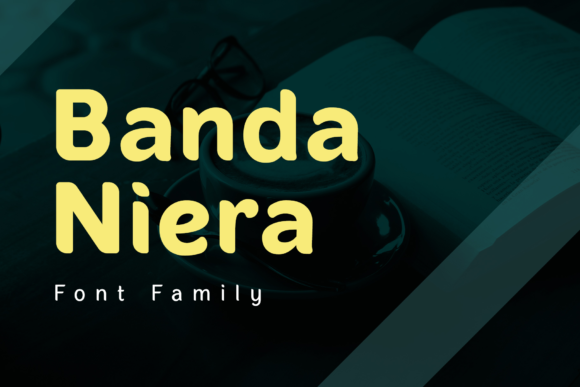
Fonts do more than spell out words—they set the tone, shape perception, and quietly influence how people feel about your brand, app, or design. Among today’s growing library of contemporary typefaces, Banda Niera stands out not for being flashy or technical, but for being genuinely approachable. It’s a sans serif font with round edges, soft curves, and a subtle bounce in its rhythm—like a friendly nod instead of a formal handshake.
What Makes Banda Niera Feel So Inviting?
At first glance, Banda Niera reads as clean and modern—but look closer, and you’ll notice the thoughtful details that give it warmth. Its rounded terminals (the ends of strokes) soften sharp transitions. Its lowercase a, c, and e open gently, avoiding tight, closed forms that can feel clinical. Even the uppercase I includes slight rounded caps—not fully circular, but just enough to avoid visual rigidity. These aren’t arbitrary choices; they’re intentional cues that signal openness, accessibility, and human-centered design.
Unlike geometric sans serifs like Montserrat or Futura—which prioritize precision and symmetry—Banda Niera leans into organic balance. Its x-height is generous, improving legibility at small sizes, while its letter spacing feels naturally even, not mechanically adjusted. That means less manual kerning for designers and fewer readability hiccups for readers scrolling on mobile.
Where Banda Niera Shines in Real Projects
You won’t find Banda Niera dominating financial dashboards or legal disclaimers—and that’s by design. Its strength lies where personality matters: children’s apps, wellness brands, creative studios, education platforms, and inclusive digital tools. Think of a meditation app guiding users through breathing exercises—the calm, rounded shapes of Banda Niera reinforce tranquility without needing extra illustrations. Or a local bakery’s website: its menu headings in Banda Niera feel warm and handmade, like the sourdough loaf featured in the hero image.
It also works beautifully in hybrid environments. Pair it with a neutral, high-contrast serif like Playfair Display for blog headers—Banda Niera handles body text with quiet confidence. Or use it solo across an entire interface: buttons, form labels, notifications, and microcopy all benefit from its consistent friendliness. Because it’s designed with UI in mind, its characters distinguish clearly—even 1, l, and I are easy to tell apart on small screens.
Designing With Intention, Not Just Aesthetics
Choosing Banda Niera isn’t just about picking a “cute” font—it’s a strategic alignment with values like clarity, empathy, and inclusivity. Brands increasingly recognize that tone isn’t only carried by voice or imagery; typography carries emotional weight too. A fintech startup targeting Gen Z and young families might choose Banda Niera over a rigid, corporate sans to signal transparency and support—not just transactions. Similarly, an NGO building a multilingual literacy tool may select it because its open shapes aid recognition for emerging readers across languages.
That said, context still rules. Banda Niera isn’t ideal for dense academic papers or long-form technical documentation where neutrality and typographic austerity support focus. But for landing pages, onboarding flows, product cards, or social media graphics? It adds polish without pretense.
Practical Considerations Before You Use It
Before downloading or licensing Banda Niera, consider these real-world factors:
- Licensing scope: Check whether your intended use—web, desktop, app embedding, or merchandise—falls under the license. Some versions include variable font axes (weight, width), which expand flexibility but may require updated build tools.
- Language support: Banda Niera covers Latin-based scripts comprehensively, including extended diacritics used in French, Spanish, Vietnamese, and Turkish. If your audience uses Cyrillic, Greek, or Arabic, verify coverage—or plan fallbacks.
- Performance impact: As a well-optimized web font, it loads quickly, especially when subsetting (e.g., removing unused glyphs). Tools like Google Fonts or self-hosted
@font-facedeclarations let you control delivery without bloating page weight. - Accessibility compliance: Its contrast ratio meets WCAG AA standards at 16px and above when paired with dark gray or black text on light backgrounds. For low-vision users, avoid light weights at small sizes—opt for Regular or Medium instead.
How Developers and Designers Collaborate Around Banda Niera
In practice, Banda Niera bridges design and development smoothly. Designers appreciate its built-in optical sizing hints and responsive behavior across breakpoints. Developers value its predictable metrics and compatibility with CSS font-variation-settings if using the variable version. A common workflow: designers define primary and secondary weights in Figma using Banda Niera’s named instances (e.g., “Medium”, “SemiBold”), then developers replicate those exact weights via font-weight values—no guesswork, no mismatched rendering.
For teams using design systems, Banda Niera slots neatly into typography scales. Try this hierarchy: Banda Niera SemiBold at 24px for H2s, Regular at 18px for H3s, and Regular at 16px for body—then adjust line height to 1.5 for comfortable reading. Its generous counters (the enclosed spaces inside letters like a and o) prevent visual crowding, even with tighter leading.
Why Banda Niera Fits Today’s Creative Landscape
We’re moving past one-size-fits-all typography. Users expect interfaces to feel personal, responsive, and emotionally intelligent—not just functional. Banda Niera answers that shift with quiet confidence. It doesn’t shout. It doesn’t distract. It supports content instead of competing with it.
Its rise mirrors broader trends: the preference for human-centered UX, the demand for inclusive design, and the growing expectation that digital experiences reflect care—not just code. It’s the kind of font you might not consciously notice… until you switch to something harsher and suddenly feel the difference in tone.
And that’s the mark of great typography: it works so well, it disappears—leaving only clarity, connection, and calm.
Getting Started With Banda Niera
Ready to try it? Start simple. Replace the body font in a single section of your site—maybe your newsletter signup or FAQ accordion—and observe how users engage. Does the tone feel more inviting? Do team members comment on improved readability during internal reviews? Small tests reveal big insights.
If you're building a new brand identity, explore Banda Niera alongside your core color palette. Its warmth pairs naturally with earthy tones, soft pastels, or even deep indigos—avoiding the starkness that can come with cooler fonts. And remember: consistency matters more than complexity. Using Banda Niera across headlines, buttons, and captions—without mixing three different display fonts—builds cohesion and trust.
Ultimately, Banda Niera isn’t about chasing trendiness. It’s about choosing a tool that helps you communicate with kindness, clarity, and quiet confidence—every time a user sees your words.