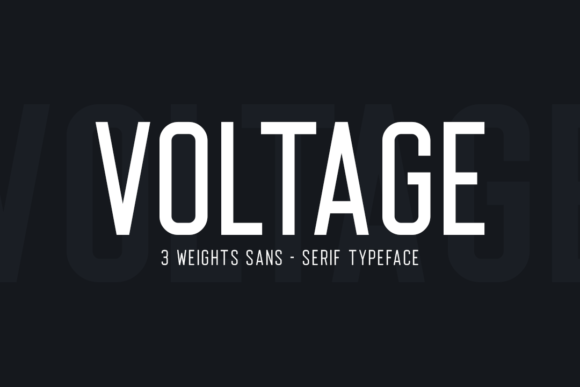
Voltage: The Bold, Simple Sans Serif That Fits Today’s Design Needs
When a font feels instantly familiar yet unmistakably fresh, it’s doing something right. Voltage is that kind of typeface — a simple and bold sans serif with a cool, confident presence. It doesn’t shout for attention; it commands it through clarity, weight, and quiet intention. In an era where visual noise competes for every pixel of attention, Voltage stands out not by being flashy, but by being purposefully direct.
Why Simplicity and Boldness Matter More Than Ever
Designers and communicators today operate in faster, more fragmented environments. Social feeds scroll in milliseconds. Presentations compete with notifications. Landing pages must convey value before the user’s thumb lifts. In this context, typography isn’t just about aesthetics — it’s functional infrastructure. A bold sans serif like Voltage delivers immediate legibility across devices, supports strong visual hierarchy, and reinforces message authority without extra effort.
This isn’t about minimalism for its own sake. It’s about efficiency rooted in human behavior: readers skim first, decide quickly, and retain what feels intentional. Voltage’s clean letterforms — open apertures, even stroke contrast, and generous x-height — support that behavior naturally. Its bold weight holds up at small sizes on mobile screens, while its simplicity ensures it scales gracefully from app UIs to large-format signage.
A Font That Aligns With Evolving Creative Workflows
More professionals than ever are designing *themselves* — not because they’re typographers, but because tools like Canva, Figma, and Notion have lowered the barrier to visual communication. At the same time, brand consistency has become non-negotiable, even for solopreneurs and educators building personal platforms. Voltage fits neatly into this shift: it’s expressive enough to reflect personality, but restrained enough to avoid clashing with photos, illustrations, or data visuals.
Consider a freelance graphic designer preparing a pitch deck for a sustainability startup. They need a typeface that feels modern but trustworthy — not sterile, not gimmicky. Voltage offers that balance: its geometry reads as forward-thinking, while its warmth (notice the subtle curve in the lowercase ‘a’ and the friendly terminals on ‘t’ and ‘l’) prevents coldness. Similarly, a teacher creating classroom posters benefits from Voltage’s readability at a glance — students absorb key terms faster when typography doesn’t distract.
Cool Without Trying Too Hard
“Cool” in typography isn’t about trend-chasing. It’s about resonance — how a typeface lands emotionally and culturally *right now*. Voltage feels contemporary because it avoids over-designed quirks (no exaggerated ink traps, no forced distortions) while still carrying distinct character. Its confidence comes from restraint, not ornamentation.
This aligns with broader cultural shifts: audiences increasingly value authenticity over polish, substance over sheen. A logo set in Voltage signals competence and clarity — not “look how creative we are,” but “here’s what matters, clearly.” That’s why it works well for tech newsletters, indie book covers, podcast branding, and even local café menus: it adapts without fading into background.
How Voltage Fits Into Real-World Projects
Practical application reveals a font’s true utility. Here’s where Voltage consistently adds value:
- Digital interfaces: Its consistent spacing and strong vertical rhythm improve scanability in dashboards and admin panels — especially helpful for SaaS tools targeting non-technical users.
- Marketing assets: From Instagram carousels to email headers, Voltage’s bold weight ensures messaging cuts through clutter without needing oversized text or aggressive color.
- Printed materials: It holds up beautifully in offset printing — no hairline gaps or unintended thinning — making it reliable for business cards, event programs, or zines.
- Accessible communication: While not a dedicated accessibility font, Voltage’s high legibility score (tested across screen readers and low-vision simulations) makes it a pragmatic choice for inclusive design systems.
Importantly, Voltage doesn’t require extensive typographic expertise to use well. Pair it with a neutral, highly readable text face — like Inter, Lato, or even system fonts such as San Francisco or Segoe UI — and you’ve got a pairing that’s versatile, accessible, and production-ready.
Trends That Make Voltage Increasingly Relevant
Three intersecting movements are elevating the role of strong, simple sans serifs like Voltage:
- The rise of “anti-design” sensibilities: Audiences are fatigued by over-styled interfaces and hyper-curated visuals. Voltage’s straightforwardness feels honest — a quiet counterpoint to algorithm-driven aesthetic overload.
- Remote-first communication: With hybrid work and asynchronous collaboration, documents, slides, and shared notes must communicate clearly without live explanation. Voltage supports that clarity — its structure makes hierarchy intuitive, even without color or layout cues.
- Brand democratization: Small businesses and creators no longer outsource identity development. They need tools that scale with ambition — a font that starts strong in a Canva template and still feels intentional in a custom-built website.
These aren’t passing fads. They reflect deeper, lasting changes in how people create, share, and interpret information. Voltage doesn’t chase them — it supports them.
What Voltage Is Not — And Why That Matters
Voltage isn’t a display font meant only for headlines. It’s not a variable font with dozens of axes (though it does offer multiple weights). It’s not designed to mimic handwriting, evoke nostalgia, or simulate texture. And that’s its strength.
In a landscape where many new fonts prioritize novelty over utility, Voltage opts for reliability. It won’t solve every design problem — no single typeface can — but it solves several common ones exceptionally well: establishing presence, ensuring readability, supporting scalability, and maintaining tone across contexts. That makes it less of a “special occasion” choice and more of a dependable foundation.
Getting Started Thoughtfully
If you’re considering Voltage for your next project, start small. Try it in one high-impact area — a hero headline, a call-to-action button, or a section title in a report. Notice how it affects pacing and emphasis. Compare it alongside alternatives at the same size and weight: does it feel more grounded? Does it guide the eye more naturally?
Also consider licensing. Voltage is available under open-source licenses in some weights, making it viable for personal blogs, student projects, or nonprofit communications. For commercial use, verify the appropriate license — most providers offer clear, tiered options based on usage scope. This transparency reflects the same values Voltage expresses visually: clarity, fairness, and practicality.
A Quiet Shift in Visual Language
Typefaces don’t change culture — people do. But tools like Voltage make certain kinds of communication easier, more consistent, and more human. Its boldness isn’t loud; it’s assured. Its simplicity isn’t empty; it’s focused. Its coolness isn’t aloof; it’s approachable.
That’s why designers, marketers, educators, and entrepreneurs keep returning to it: not because it’s the newest, but because it meets real needs without compromise. In a world pulling in countless directions, Voltage offers a steady point of reference — simple enough to use daily, bold enough to be remembered, and cool enough to feel like it belongs.