Helendia: A Smooth, Rounded Font for Thoughtful Design Choices
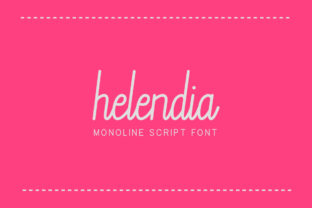
Helendia is a smooth and lovely round font—designed with gentle curves, consistent stroke weight, and balanced proportions. It belongs to the humanist sans-serif category but distinguishes itself through its soft geometry and approachable warmth. Unlike many rounded typefaces that lean heavily into playfulness or childlike simplicity, Helendia maintains visual clarity at small sizes and typographic integrity in longer text blocks. Its design reflects careful attention to rhythm, spacing, and optical balance—not just shape.
What Sets Helendia Apart from Other Rounded Fonts
Rounded fonts span a wide spectrum—from ultra-minimalist geometric variants to expressive, hand-drawn interpretations. Helendia occupies a middle ground: it’s not as rigid as a circle-based monoline font, nor as irregular as a brush-script-inspired alternative. Its terminals are softly tapered, its counters open and airy, and its x-height generous without overwhelming ascenders or descenders. This makes Helendia legible in UI interfaces, effective in branding systems, and surprisingly versatile in editorial layouts.
Compared to more utilitarian sans-serifs like Inter or Open Sans, Helendia introduces subtle personality without sacrificing neutrality. Where those fonts prioritize function above all, Helendia offers function *with* character—making it especially useful when tone matters: a wellness brand, an education platform, or a civic initiative seeking warmth and accessibility.
Where Helendia Excels—and Where It May Fall Short
Helendia performs well in contexts where readability and emotional resonance both matter. For example:
- A mental health app using Helendia for interface labels and onboarding screens—its softness supports calm, non-intimidating interaction.
- A children’s learning website pairing Helendia for headings with a more neutral body font—its friendliness draws attention without distracting from content.
- A sustainable product label combining Helendia with modest tracking weights and ample letter spacing—its organic feel aligns with natural materials and thoughtful craftsmanship.
That said, Helendia isn’t optimized for every scenario. In dense data tables or technical documentation requiring tight line spacing and high information density, its rounded forms can reduce contrast and slow scanning. Similarly, in large-scale signage viewed from distance, its softer terminals may lose definition compared to fonts with sharper terminations or higher contrast.
It also lacks extensive language support in some releases—so if your project requires extended Latin, Cyrillic, or Greek coverage—or includes diacritical marks common in multilingual publishing—you’ll need to verify the specific version you’re evaluating. Not all weights include full OpenType features like stylistic alternates or case-sensitive punctuation, which matters for refined typographic control.
For Branding and Identity Systems
When developing a brand identity, typeface choice signals values before a single word is read. Helendia conveys approachability, care, and intentionality—qualities that resonate with audiences prioritizing empathy and authenticity. It pairs effectively with restrained serif companions (e.g., a low-contrast serif like Literata or Cormorant Garamond) for contrast without contradiction. Unlike highly stylized display fonts, Helendia avoids limiting future application—it scales across digital, print, and environmental formats without needing constant redesign.
For Digital Interfaces
In web and mobile interfaces, Helendia’s even rhythm and open apertures aid scannability—especially at smaller sizes. Its moderate width prevents crowding in navigation bars or form fields. However, developers should test rendering across operating systems: while modern browsers handle its hinting well, older Android versions or legacy Windows environments may soften its curves slightly, affecting perceived crispness. If pixel-perfect consistency is critical across all platforms, a more engineered system font or a variable font with robust hinting may be preferable.
For Editorial and Long-Form Text
Helendia was not designed primarily as a text face—and this shows in extended reading. Its uniform roundness, while pleasant in short bursts, can blur word shapes over paragraphs, reducing reading speed for some users. For magazine spreads or blog posts exceeding 300 words, pairing Helendia with a dedicated text font (such as Lora, Source Serif, or even a more neutral sans like Roboto Serif) yields stronger hierarchy and better fatigue resistance. Using it exclusively for body copy may work in short-form newsletters or illustrated essays—but expect tradeoffs in sustained readability.
Key Decision Factors When Evaluating Helendia
Choosing Helendia—or deciding against it—comes down to alignment with your project’s functional and expressive goals. Consider these practical questions:
- What’s the primary role of typography here? Is it supporting quick comprehension (e.g., dashboards), reinforcing brand voice (e.g., packaging), or guiding emotional response (e.g., landing pages)? Helendia shines most when voice and usability intersect.
- Who is the audience—and how will they engage? Readers scanning on mobile benefit from its open letterforms; professionals reviewing technical specs may prefer tighter spacing and sharper distinction between characters.
- What’s the implementation environment? Will it appear mostly in controlled settings (e.g., a branded app with known OS constraints), or broadly across third-party platforms (e.g., social media graphics, email clients, PDF exports)? Broader distribution increases variability in rendering.
- How much typographic flexibility do you need? If your design system requires multiple optical sizes, extensive language coverage, or fine-grained control over figure styles and ligatures, check whether the Helendia family provides those options—or whether supplementing with another font is necessary.
Realistic Alternatives Worth Considering
No single font solves every problem—and Helendia is no exception. Depending on your needs, alternatives may offer better fit:
- For broader language support and tighter text performance: Nunito or Quicksand offer similar warmth but with expanded character sets and more refined text weights.
- For greater technical precision in UI: Inter or IBM Plex Sans provide excellent screen legibility, extensive weights, and strong cross-platform consistency—though with less inherent personality.
- For expressive yet mature rounded aesthetics: Circular Std or GT Walsheim Plus bring more structural rigor and optical tuning, especially at larger sizes—ideal when Helendia feels too soft for your brand’s maturity level.
The goal isn’t to find the “best” font overall—but the best one for this context, these readers, and this set of constraints. Helendia earns its place when softness serves strategy—not just style.
Making the Call: When Helendia Is the Right Choice
Helendia is often the right choice when:
- You need a friendly, inclusive tone without veering into informality or whimsy.
- Your design system benefits from a cohesive, warm anchor—especially alongside neutral or structured supporting fonts.
- You’re working within a defined scope (e.g., a single app, campaign, or publication) where typographic consistency is achievable and controllable.
- You value aesthetic cohesion across touchpoints—and Helendia’s balanced proportions translate reliably from screen to print to motion.
It’s less ideal when:
- Legibility under time pressure or variable conditions is paramount (e.g., emergency interfaces, industrial dashboards).
- You require extensive typographic variation—multiple widths, optical sizes, or deep OpenType functionality—beyond what the current Helendia release provides.
- Your audience includes users with low vision or reading differences who rely on high-character-differentiation fonts—and testing shows Helendia reduces recognition speed in your context.
Ultimately, Helendia invites intentionality. It doesn’t disappear into the background like a utility font—but neither does it dominate like a display face. It occupies a thoughtful middle space: present enough to shape perception, quiet enough to let content lead. That balance, when matched to the right project, makes Helendia more than just a font—it becomes part of the reasoning behind the design.