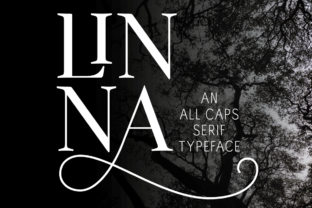
Linna
Linna is an all-caps serif font built for presence—not just readability, but impact. It’s not a revival of old letterforms or a minimalist reinterpretation. Instead, Linna draws from humanist type traditions while deliberately embracing distinct, confident shapes: generous x-heights, open counters, and subtle variations in stroke weight that give each character its own quiet personality. You’ll notice it first in headlines—bold, grounded, and unmistakably intentional—but its usefulness stretches far beyond the top of the page.
Where Linna Finds Its Footing (and Why It Stays)
Think about the last time you saw a logo that felt both timeless and quietly modern—maybe on a ceramic studio’s business card, a boutique hotel’s welcome sign, or the cover of an indie literary journal. Chances are, Linna was working behind the scenes. Its all-caps structure isn’t restrictive; it’s clarifying. When every letter stands tall and evenly spaced, hierarchy becomes intuitive—even at small sizes on physical signage.
Brands in creative industries lean into Linna for precisely this reason: it communicates craft without shouting. A textile designer launching a limited-edition capsule collection might use Linna for product tags and packaging headers—not because it’s “trendy,” but because its humanist warmth balances the precision of hand-dyed fabric labels. Likewise, independent bookshops often pair Linna with a soft, readable sans-serif for body text. The contrast feels deliberate, respectful of both content and reader.
Real-World Scenarios Where Linna Adds Quiet Authority
- Event branding for intimate gatherings: Think wedding stationery, gallery openings, or academic symposia. Linna’s even rhythm and generous spacing hold up beautifully in engraved invitations or laser-cut acrylic signage—no awkward crowding, no visual fatigue, even after hours of reading name tags or program schedules.
- Product labeling for premium goods: Artisanal coffee roasters, small-batch skincare lines, and craft distilleries use Linna to signal intentionality. On a matte-finish bottle label, its serifs catch light just enough to feel tactile—like the product itself—without competing with photography or ingredient lists.
- Digital interfaces with editorial weight: Newsletters from independent publishers, portfolio sites for illustrators, or membership dashboards for cultural nonprofits often deploy Linna sparingly—for section dividers, featured article titles, or callout quotes. It adds gravitas without slowing down the experience. Because it’s optimized for display use, it renders crisply across devices—even on older tablets where some variable fonts struggle.
Who Benefits—and How Their Needs Shape Linna’s Role
A graphic designer choosing Linna for a client’s rebrand isn’t just picking a font—they’re selecting a tone partner. For a sustainability consultancy, Linna’s clarity reinforces trustworthiness; its lack of ornamentation mirrors their no-fluff approach to reporting. For a children’s book illustrator building a personal brand, Linna’s friendly proportions (notice how the ‘O’ and ‘C’ feel gently rounded, not rigid) soften the formality of all-caps—making it feel inviting, not austere.
Even non-designers find value in Linna. Educators creating classroom posters appreciate how its strong letterforms improve legibility from across a room—especially for students with visual processing differences. Museum educators use it for exhibit title panels because it holds up under varied lighting and doesn’t “vibrate” next to high-resolution photography. And developers integrating custom fonts into static site generators often cite Linna’s lightweight file size and straightforward CSS implementation as a practical win—no complex fallback chains needed.
What to Consider Before Bringing Linna Into Your Work
Linna shines brightest when used intentionally—not ubiquitously. Because it’s all-caps by design, it’s not ideal for long paragraphs, interface buttons requiring quick scanning (“Submit”, “Cancel”), or multilingual layouts where uppercase diacritics (like Ñ or Ž) may feel cramped. Always test how it behaves with your specific language set, especially if supporting Central or Eastern European scripts.
Spacing matters more with Linna than with many display fonts. Its default letter-spacing is generous, which supports breathability—but in tight contexts (like narrow mobile navigation bars), you may need to adjust tracking manually. Most design tools handle this intuitively, and CSS offers precise control via letter-spacing. Don’t skip this step: too-tight Linna loses its openness; too-loose, and it starts to feel disconnected.
Also consider context contrast. Linna pairs naturally with low-contrast, neutral sans-serifs (think Inter, Poppins, or even system fonts like SF Pro). Avoid pairing it with other high-impact serifs or decorative display fonts—the conversation gets noisy. Its strength lies in standing out *just enough*, not dominating.
Strengths That Translate to Everyday Use
Linna’s humanist roots mean it avoids mechanical rigidity. Look closely at the lowercase ‘a’ and ‘g’ in its companion text weights (if available), or how the terminals on ‘T’ and ‘E’ soften just slightly—these aren’t flourishes; they’re cues that invite engagement. That subtlety makes Linna resilient across mediums: it looks equally at home on a woven linen tote bag as it does in a PDF annual report viewed on a laptop.
It’s also highly legible at distance and in motion. Motion designers use Linna for lower-thirds in documentary interviews because its sturdy forms remain recognizable even when overlaid on busy backgrounds or scaled dynamically during transitions. And because its vertical stress is moderate—not extreme like Didone fonts—it avoids the “flicker” sometimes seen in video playback.
When Linna Might Not Be the Right Fit
If your project demands rapid scannability—like a public transit app, emergency alert system, or dense data dashboard—Linna’s thoughtful pacing works against speed. Similarly, brands leaning heavily into playful, youthful, or tech-forward identities (think AR startups or Gen Z-focused apparel) may find Linna’s quiet confidence reads as overly reserved. It doesn’t try to be everything—and that’s part of its reliability.
And while Linna handles print beautifully, avoid using it for tiny fine print (under 8pt) in brochures or legal disclaimers. Its serifs and open shapes need breathing room to function as intended. In those cases, a crisp, no-nonsense sans-serif remains the pragmatic choice—leaving Linna free to do what it does best: anchor attention, not vanish into the background.
Putting Linna to Work—Without Overthinking It
You don’t need a full brand audit to start benefiting from Linna. Try it on your next Instagram highlight cover—its caps-only nature eliminates case-conversion headaches. Drop it into a Canva presentation slide as a section header and see how much cleaner your flow feels. Print a single line of Linna on textured paper and hold it beside your current go-to font. Notice where your eye rests first. That’s Linna doing its job: not drawing attention to itself, but making sure the message lands—clear, calm, and completely human.