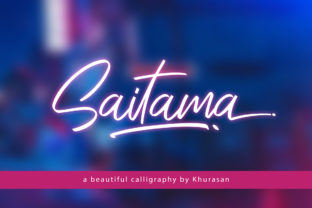
Saitama: A Gorgeous Handwritten Font
Saitama isn’t a city or a superhero—it’s a font. And not just any font: it’s a gorgeous, light handwritten typeface that carries the effortless charm and bold personality of 1980s design. Think neon-lit signage, hand-painted concert posters, and spontaneous sketchbook notes—captured in clean, digital form. Saitama balances legibility with expressive flair, making it ideal for projects where warmth, authenticity, and visual impact matter.
Why Saitama Fits More Than One Kind of Creator
Different people reach for fonts for different reasons—and Saitama responds to several of them, without demanding expertise or expensive tools. Its appeal isn’t universal, but it *is* deeply resonant for specific goals and mindsets.
For Beginners Who Want Personality Without Complexity
If you’ve ever opened a design app, stared at a blank canvas, and thought, “I don’t know how to make this look good,” Saitama offers an easy win. It doesn’t require kerning adjustments or color theory knowledge to shine. Drop it into a Canva social post, a Google Slides title slide, or a simple Instagram Story—and suddenly, your message feels intentional and alive. No tutorials needed. Just pick a size, add contrast (a dark background works beautifully), and go.
For Educators Building Warm, Engaging Learning Materials
Teachers and course creators often struggle to balance professionalism with approachability—especially in online settings. Saitama helps bridge that gap. Used sparingly for headings, quote callouts, or welcome banners in LMS dashboards, it signals care and human presence. One high school art teacher uses it for weekly “creative challenge” announcements; students say it feels like a note from a favorite instructor—not a corporate template. It’s not for body text, but as a voice amplifier? Yes.
For Freelancers and Small Business Owners Seeking Distinctive Brand Touches
When you’re competing for attention on crowded platforms—whether Etsy, LinkedIn, or a local farmers’ market booth—small typographic choices compound. Saitama gives handmade goods, wellness services, or boutique consulting a tactile, memorable edge. A ceramicist uses it on product tags and website hero text; a yoga studio pairs it with clean sans-serif body copy for class descriptions. It says “thoughtful” and “human-made,” not “mass-produced.” Importantly, it scales well across print and screen—no pixelation, no awkward spacing surprises.
For Marketers and Bloggers Adding Visual Rhythm to Content
Long-form content can feel flat without strategic visual breaks. Saitama excels as a stylistic anchor: use it for pull quotes, section dividers, or featured testimonials. Unlike heavy script fonts, its light weight keeps pages breathable. A food blogger applies it only to recipe titles and ingredient headers—enough to guide the eye, not enough to distract from photos or instructions. That restraint is key: Saitama works best when it supports, not dominates.
What to Consider Before You Use Saitama
It’s lovely—but it’s not neutral. Understanding its strengths (and limits) helps you decide whether it aligns with your project’s needs.
- Ease of use: Installs like any OpenType font. Works in Adobe apps, Figma, Affinity Suite, and most web builders with custom font upload support.
- Legibility: Excellent at larger sizes (24pt+), less ideal for dense paragraphs or small UI labels. Avoid using it below 16pt in print or 18px on screen.
- Flexibility: Comes in one weight (light) and includes standard Latin characters, numerals, and basic punctuation. No italics or bold variants—so pairing matters. Try Montserrat, Inter, or Source Sans for contrast.
- Commercial use: Check the license. Most versions allow personal and commercial use, including client work and merchandise—but always verify before selling products featuring Saitama prominently.
- Speed & reliability: As a static font file (not variable or web-optimized by default), it loads quickly. For websites, convert to WOFF2 and serve via @font-face for optimal performance.
Real Projects, Real Decisions
A freelance graphic designer chose Saitama for a nonprofit’s annual report cover—not for every headline, but just the main title and chapter openers. Why? Because the organization works with youth, and the font subtly echoed the energy of student artwork inside the report. It wasn’t about trend-chasing; it was about continuity of voice.
A hobbyist lettering artist downloaded Saitama to study stroke rhythm and baseline variation. She traced glyphs in Procreate, comparing Saitama’s subtle bounce to her own hand-drawn letters. For her, it wasn’t a final tool—it was a quiet teacher.
A small publishing imprint used Saitama for the spine and back-cover tagline of a poetry chapbook. The poet wanted “something soft but confident”—and Saitama delivered without competing with the delicate serif used for the poems themselves.
Does Saitama Match Your Goals?
Ask yourself:
- Are you aiming for warmth, spontaneity, or nostalgic energy—not sleek minimalism or corporate authority?
- Will it appear in places where readers have time to absorb it (headlines, posters, covers) rather than fast-scrolling interfaces?
- Do you need flexibility across weights or languages? (If yes, consider pairing it—or choosing a more expansive family.)
- Is your audience likely to respond to human imperfection in type? (Some prefer precision; others connect with gentle irregularity.)
Saitama won’t solve every typographic problem. It won’t replace a robust brand system or compensate for weak layout. But when your goal is to invite, delight, or gently surprise—when you want your words to feel written, not rendered—it earns its place.
It’s not flashy in a loud way. It’s flashy in the way sunlight catches handwritten chalk on a sidewalk: fleeting, personal, and unmistakably alive.