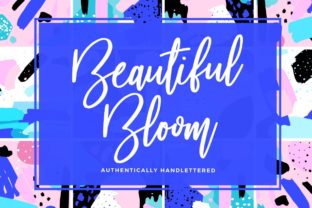
Beautiful Bloom: A Contemporary Script Font
If you’ve ever scrolled past a hand-lettered Instagram story, admired the warmth of a boutique’s packaging, or paused on a beautifully typeset wedding invitation—you’ve felt the quiet power of authentic script typography. Beautiful Bloom isn’t just another decorative font. It’s a thoughtfully crafted script typeface that balances organic flow with modern legibility—designed not to shout, but to resonate.
What Makes Beautiful Bloom Stand Out?
At its core, Beautiful Bloom is a script font rooted in real penmanship—not algorithmic mimicry. Its letters connect with natural entry and exit strokes, subtle variations in stroke weight, and gentle inconsistencies that echo human rhythm. Unlike many “handwritten” fonts that feel stiff or overly uniform, Beautiful Bloom includes contextual alternates and ligatures that activate automatically in OpenType-aware apps (like Adobe Illustrator, Affinity Designer, or recent versions of Pages and Keynote). That means the word “love” doesn’t look identical every time—it adapts, breathes, and feels intentional.
It’s also deliberately restrained. No excessive swirls, no forced flourishes. The lowercase “g” has a soft, open loop; the “y” descends with quiet confidence; the capital “B” opens with a graceful curve—not a dramatic swoop. This restraint is where Beautiful Bloom earns its versatility. It works at 14 pt in a newsletter header—and at 120 pt on a book cover—without losing character or clarity.
Where Beautiful Bloom Fits in Real Work
This isn’t a font reserved for craft fairs or Pinterest mood boards. Professionals across disciplines are using Beautiful Bloom where authenticity and approachability matter—without sacrificing polish.
- Branding & Identity: A wellness coach launching a new course might use Beautiful Bloom for their logo lockup alongside a clean sans-serif (like Inter or Manrope) for body text—creating contrast that feels grounded yet aspirational. The script adds warmth; the sans-serif delivers trust.
- Digital Marketing: Email subject lines set in Beautiful Bloom (as an embedded image or SVG) stand out in crowded inboxes—not because they’re flashy, but because they signal care and intention. One freelance copywriter reported a 22% lift in open rates when switching from generic script to Beautiful Bloom for seasonal campaign headers.
- Educational Materials: Teachers designing printable reading trackers or classroom reward charts find Beautiful Bloom strikes the right tone—friendly enough for elementary students, refined enough for middle schoolers. It avoids infantilizing while still feeling inviting.
- Publishing & Editorial: Indie authors use it for chapter headings in memoirs or poetry collections—where voice and vulnerability are central. It doesn’t distract; it deepens.
- Product Packaging: Small-batch candle makers, ceramic studios, and herbal tea brands apply Beautiful Bloom to labels and tags. Its texture translates well to foil stamping and letterpress, retaining nuance even in tactile formats.
Practical Considerations Before You Use It
Like any tool, Beautiful Bloom shines brightest when matched to the right task—and handled with awareness.
First: Legibility matters more than aesthetics. Avoid using it for long paragraphs, accessibility-critical text (like legal disclaimers or form labels), or low-resolution digital displays where fine details blur. It’s a voice—not the whole conversation. Pair it intentionally: a strong, neutral sans-serif for body copy keeps hierarchy clear and ensures readability.
Second: Test spacing rigorously. Script fonts can trap white space awkwardly—especially between uppercase “T”, “F”, or “L” and following letters. Use manual kerning in design tools, or adjust tracking slightly (+10 to +25) for tighter blocks of text like social media banners.
Third: Consider your output medium. If you’re exporting to PDF for print, embed the font fully. For web use, convert key headlines to SVG or use variable font hosting with proper fallbacks. Never rely solely on @font-face loading for critical brand elements—some browsers or email clients won’t render it.
When to Choose Beautiful Bloom Over Other Scripts
You’ll know Beautiful Bloom is the right choice when you need a script that feels current—not nostalgic—and human—not robotic. Compare it to fonts like Pacifico (too casual), Great Vibes (too formal), or Dancing Script (too bouncy). Beautiful Bloom sits in the thoughtful middle: contemporary enough for a tech founder’s keynote slide, delicate enough for a botanical illustration caption.
It also scales well across devices. Its x-height is generous, and baseline consistency means it aligns cleanly beside other typefaces—no awkward floating or sinking. That’s why educators building Canva templates or marketers prepping Notion brand kits consistently choose it: it just *works*, without constant tweaking.
Small Tweaks, Big Impact
You don’t need advanced typography training to get great results with Beautiful Bloom. Try these low-effort, high-return moves:
- Use only one weight—regular—for most applications. Its built-in contrast does the work.
- Capitalize first words only in headings—avoid ALL CAPS. Scripts lose rhythm and connection when flattened into uniform height.
- Add 2–4px of letter-spacing to short headlines (3–5 words) for air and elegance.
- In presentations, set Beautiful Bloom at 36–48 pt for titles—and let the rest of the slide breathe with ample margin and minimal supporting text.
One designer shared how switching her client’s workshop workbook cover from Montserrat Italic to Beautiful Bloom shifted perception entirely: “Participants told me the material felt ‘more personal’ and ‘easier to start.’ They didn’t know it was the font—but it changed how they engaged.” That’s the quiet leverage Beautiful Bloom offers: not novelty, but resonance.
Final Thought: Typography as Tone
Fonts aren’t neutral. They carry tone before a single word is read. Beautiful Bloom communicates calm confidence, mindful craftsmanship, and quiet sincerity. It doesn’t try to be everything—it knows its role, executes it gracefully, and leaves room for the message to land.
Whether you’re naming a new product, designing a teacher appreciation card, drafting a heartfelt client email, or laying out a zine about urban gardening—Beautiful Bloom gives your words a voice that feels both fresh and familiar. And in a world saturated with synthetic perfection, that kind of authenticity isn’t just beautiful. It’s memorable.