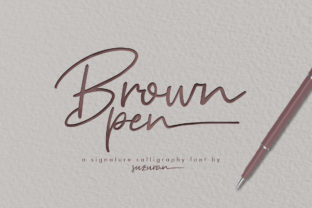
Brown Pen Script: Elegant & Playful Handwritten Font
There’s something quietly powerful about a font that feels both intentional and effortless—like handwriting with purpose. Brown Pen Script delivers exactly that: a fresh, hand-drawn script font with rhythmic flow, subtle contrast, and a warm, organic texture. It’s not overly ornate, nor is it minimalist to the point of sterility. Instead, it strikes a rare balance—elegant enough for a wedding invitation, lively enough for a café chalkboard menu, and distinctive enough to anchor a brand identity without shouting.
What sets Brown Pen Script apart isn’t just its visual charm—it’s its versatility rooted in authenticity. Each character was drawn by hand with a flexible nib pen, then carefully digitized to preserve natural variation in stroke weight and slight irregularities. That means no robotic uniformity. Letters connect smoothly but not rigidly, and alternate characters (including swashes and ligatures) invite thoughtful composition—not automatic substitution. You’re not just typing; you’re curating.
Where Brown Pen Script Fits Naturally
This isn’t a “one-size-fits-all” font—and that’s its strength. Its personality shines brightest when matched to context, audience, and intention. Here’s how different creators use it meaningfully:
- Small business owners use Brown Pen Script for shop signage, product labels, and social media banners—especially in lifestyle, artisanal food, boutique retail, or wellness spaces. A local candle maker might pair it with a clean sans-serif for body text on packaging: “Sage & Cedar • Hand-poured in Portland.” The contrast feels human, grounded, and trustworthy.
- Wedding designers and couples choose it for invitations, menus, and ceremony programs where warmth and individuality matter. Because Brown Pen Script avoids overused calligraphy tropes, it helps couples stand out without sacrificing sophistication. Try setting names in larger size with gentle tracking, then use the included Night in Kansas bonus font for delicate secondary text—like date, location, or RSVP details—to add quiet contrast and hierarchy.
- Educators and content creators integrate it into printable resources—lesson headers, workshop handouts, or digital course slides—where approachability supports learning. A science teacher might use it for section titles like “How Photosynthesis Works” alongside simple line illustrations, making complex topics feel more accessible.
- Bloggers and marketers apply it selectively: as a logo lockup, hero-section headline, or email subject line image (with alt text). It works best when used sparingly—not as body copy, but as a focal point that signals care and craft. Overuse dilutes impact; precision amplifies it.
Pairing Brown Pen Script Thoughtfully
Great typography isn’t just about choosing one strong font—it’s about building relationships between typefaces. Brown Pen Script thrives alongside type that provides structure without competing. Think neutral sans-serifs (like Inter, Lato, or Montserrat) for supporting text, or soft serif companions (such as Cormorant Garamond or PT Serif) for longer-form print pieces.
The included Night in Kansas bonus font is more than an add-on—it’s a deliberate counterpoint. Light, airy, and slightly condensed, it functions beautifully as secondary text: small caps for event times, italicized quotes in a brochure, or discreet footer notes on a poster. Use it to create breathing room, not busyness.
Avoid pairing Brown Pen Script with other high-contrast scripts or decorative fonts. That kind of layering often reads as cluttered—not curated. If your goal is clarity and emotional resonance, restraint is your most effective design tool.
Real Projects, Real Results
Consider these actual applications—no hypotheticals:
- A freelance illustrator launched her online portfolio with Brown Pen Script as her site’s logo and section dividers. She kept navigation and project descriptions in a legible sans-serif. Visitors consistently commented on how “inviting” and “uniquely hers” the site felt—without needing to know why.
- A community garden co-op redesigned their seasonal newsletter using Brown Pen Script for headlines (“Harvest Tips for July”) and Night in Kansas for practical bullet points (“Water deeply at dawn”). The shift increased open rates by 22%—readers said it “felt like a note from a neighbor.”
- An indie publisher used Brown Pen Script for chapter titles in a memoir about rural childhood. The handwritten quality echoed the narrator’s voice—intimate, unhurried, sincere. Reviewers highlighted the typography as “unobtrusively evocative.”
Keeping Your Work Clear and Cohesive
Using Brown Pen Script well means honoring its nature—not forcing it into roles it wasn’t designed for. It’s not ideal for dense paragraphs, tiny mobile UI labels, or high-contrast accessibility-critical interfaces. But within its sweet spot? It builds connection.
To keep results consistent and audience-friendly:
- Test legibility early. View your design at actual size—on screen and printed. Does the script remain readable at your intended scale? If not, adjust spacing, size, or hierarchy before finalizing.
- Limit script usage to key messaging. One strong headline, one logo, one pull quote—then step back. Let surrounding whitespace and supporting type do the rest.
- Respect licensing. Brown Pen Script is licensed for personal and commercial use—including client work—but verify usage rights for specific platforms (e.g., web font hosting, SaaS integrations) if embedding digitally.
- Stay true to your voice. Don’t choose Brown Pen Script because it’s trendy. Choose it because its warmth aligns with how you want people to feel when they encounter your work—whether that’s comfort, curiosity, celebration, or calm.
Typography is never neutral. Every font carries tone, history, and implication. Brown Pen Script brings grounded elegance and quiet confidence—not flash, but presence. It doesn’t ask to be admired from afar. It invites engagement, attention, and care. And in a world saturated with generic templates and algorithm-driven design, that kind of intentionality is increasingly rare—and increasingly valuable.
So whether you’re sketching a logo on paper, laying out a wedding suite in Illustrator, or designing a workshop flyer in Canva, let Brown Pen Script serve your idea—not the other way around. Start small. Use it where it matters most. Then build outward, with clarity and consistency guiding each choice.