Cinnamon Sugar Script: A Hand-Lettered Font with Personality
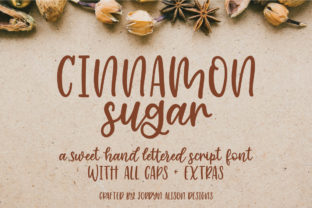
There’s a quiet magic in fonts that feel handmade—not just drawn, but *lived in*. Cinnamon Sugar Script is one of those rare typefaces: a hand-lettered script font built for real-world use, not just display. It’s not overly ornate or fussy. It’s warm, approachable, and full of subtle character—like handwriting you’d trust to sign a birthday card, label a mason jar, or headline a small-batch product.
What Makes It Stand Out (Beyond the Name)
Cinnamon Sugar Script isn’t just “another script font.” Its strength lies in thoughtful construction and practical versatility. It features a cohesive all-caps set designed specifically to complement the lowercase script—not compete with it. That means headlines and subheads retain rhythm and balance, even when mixing cases. No awkward spacing, no forced hierarchy.
Built-in ligatures and stylistic alternates give you control without complexity. Swap an “f” + “i” combo for a smoother connection. Choose a bouncier “a,” a tighter “g,” or a more open “s”—all accessible through standard OpenType features in design apps like Adobe Illustrator, Affinity Designer, or even modern versions of Canva. You don’t need coding skills or plugin subscriptions. Just click, type, and refine.
Real Projects, Real Users
Designers often ask: “Where does this actually work?” Here’s where Cinnamon Sugar Script earns its place in your toolkit:
- Small business branding: A local bakery, candle maker, or plant shop can use the script for shop signage and packaging labels—and pair the all-caps version for clean, friendly store banners or menu headers. The contrast feels intentional, not accidental.
- Educational materials: Teachers and curriculum designers use it for printable worksheets, classroom posters, or student-facing slide decks where warmth supports engagement—especially for younger learners or wellness-focused content.
- Digital content: Bloggers and newsletter creators apply it sparingly for section dividers, pull quotes, or featured headlines. Used at 24–36pt on light backgrounds, it adds visual texture without sacrificing readability.
- Printed goods: Wedding stationery designers use it for names and dates; hobbyists laser-cut it onto wood signs or embroider it onto tea towels. Its moderate stroke contrast holds up well across mediums.
How to Use It Well (Without Overdoing It)
Script fonts invite play—but clarity always comes first. Here’s how to keep Cinnamon Sugar Script effective, not exhausting:
- Limit script usage to key focal points. Reserve it for headlines, short quotes, logos, or accent text. Body copy? Stick with a clean, highly legible sans serif or serif.
- Respect line length and spacing. At smaller sizes (<14pt), avoid tight tracking or complex ligature chains. Let letters breathe—especially in digital formats where screen resolution varies.
- Test contrast early. Pair it with neutral backgrounds (soft white, warm gray, cream) rather than busy textures or low-contrast colors. If your audience includes readers over 40 or those with visual preferences, prioritize legibility over flourish.
- Stay consistent with voice. If your brand voice is playful and handmade, Cinnamon Sugar Script reinforces that. If your tone is formal or technical, it may clash—no matter how beautiful the letterforms are.
Adapting It Across Platforms and Audiences
You don’t need one “right” way to use Cinnamon Sugar Script—you need the right way *for your context*.
For social media marketers: Use the all-caps variant for Instagram story highlights (“TIPS”, “NEW”, “SALE”)—it reads fast and feels human. Avoid long captions in script; instead, layer short phrases over photos using subtle drop shadows or light outlines for contrast.
For educators and course creators: Apply it to learning module titles or milestone badges (“Week 3: Build Your First Layout”). The lowercase script adds friendliness to otherwise dense topics like web design or financial literacy—making concepts feel less intimidating.
For freelance designers: Offer Cinnamon Sugar Script as part of a brand identity package—but include clear usage guidelines. Show clients exactly where it works (logo lockups, email headers) and where it doesn’t (legal disclaimers, navigation menus). That builds trust and prevents misuse down the line.
For hobbyists and crafters: Print it at high resolution for iron-on transfers or vinyl cutting. Adjust kerning manually for curved surfaces (like mugs or jars) so letters follow the contour naturally—not forced, not stretched.
A Word on Originality and Consistency
Using a popular font doesn’t mean your work lacks originality—it means you’re choosing tools with intention. What makes your use of Cinnamon Sugar Script distinctive is how you combine it: the color palette you choose, the photography or illustration style it sits beside, the spacing and scale decisions you make.
Consistency matters more than novelty. If you use the “swash y” alternate in one headline, use it again elsewhere in that same project—unless you’re deliberately shifting tone. Small details like that build cohesion, especially across multi-page documents or multi-channel campaigns.
And remember: fonts support ideas—they don’t replace them. Cinnamon Sugar Script won’t fix weak messaging or unclear strategy. But when paired with strong content and thoughtful layout, it helps your message land with warmth, authenticity, and quiet confidence.
Getting Started—Practically
You don’t need a big budget or years of typography training. Start simple:
- Download the font and install it system-wide.
- Type a single word—“hello”, “fresh”, “gather”—in both lowercase script and all-caps variants. Compare how each feels in your layout.
- Try three different pairings: one with a geometric sans (like Montserrat), one with a warm serif (like Lora), and one with a neutral monospace (for contrast).
- Print one version. View it on phone and desktop. Ask: Does it read instantly? Does it reflect the feeling I want?
Cinnamon Sugar Script invites creativity—not perfection. It’s made for people who make things, share ideas, launch services, teach skills, and build community. Not because it’s flashy, but because it’s reliable, expressive, and quietly confident—just like the work you do.