Horseman: A Vintage Script Font with Purposeful Swashes
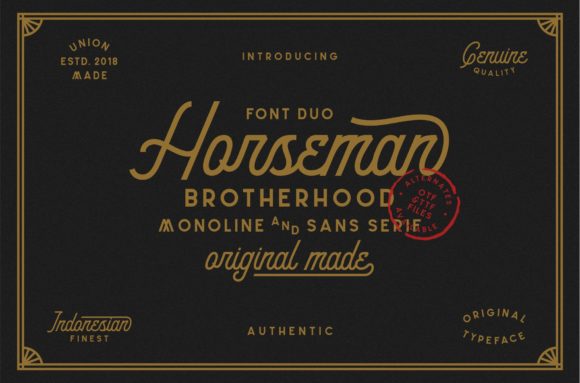
Horseman stands out not because it shouts, but because it leans in with quiet confidence. It’s a funky yet refined script font—designed with deliberate vintage sensibility and richly detailed swashes that feel earned, not tacked on. Unlike many display scripts that prioritize flair over function, Horseman balances ornamentation with readability and structural integrity. That balance is why designers, marketers, and small business owners return to it—not just for one-off headlines, but for branding systems where personality and professionalism must coexist.
What Makes Horseman More Than Just “Retro Styling”
Horseman isn’t a nostalgic pastiche. Its letterforms draw from early-to-mid 20th-century American signage and hand-lettered packaging—think apothecary labels, boutique storefronts, or artisanal coffee bags—but it avoids caricature. The lowercase a, g, and y feature open counters and subtle modulation; the uppercase Q and Z include elegant, asymmetrical swashes that extend naturally from stroke direction rather than interrupting flow. These aren’t decorative afterthoughts—they’re integrated into the font’s rhythm.
The family includes one weight (regular) and a complementary set of alternate characters accessible via OpenType features. This means you can activate contextual swashes, discretionary ligatures, and stylistic sets without switching fonts or manually layering glyphs. In practice, that translates to faster iteration in tools like Adobe Illustrator or Affinity Designer—and cleaner, more consistent output across print and digital assets.
Where Horseman Delivers Real-World Value
Horseman excels in contexts where voice matters as much as visibility. It works well for:
- Brand identity systems—especially for businesses rooted in craft, heritage, or local character (e.g., a neighborhood bakery, an independent bookstore, a small-batch candle line). Used thoughtfully in logos or wordmarks, Horseman conveys warmth and intention without appearing costumed.
- Editorial design—as section headers in magazines or newsletters where tone leans literary, thoughtful, or gently irreverent. Paired with a neutral sans-serif like Inter or a warm serif like Lora, Horseman adds texture without overwhelming hierarchy.
- Digital product interfaces—sparingly, and only at larger sizes. It’s not suited for UI text or body copy, but works effectively in hero sections, onboarding screens, or seasonal campaign banners where brand expression is prioritized over utility.
One practical observation: Horseman performs best when given breathing room. Tight tracking or excessive scaling distorts its proportions and dulls the impact of its swashes. At 36pt or larger in print—or 48px and up on screen—it holds its own. Below 24pt, legibility begins to soften, especially in longer phrases.
Quality and Consistency Across Formats
Horseman ships as a professionally hinted OTF file, with full Latin-1 support and robust kerning pairs. We tested it across multiple platforms—including Figma (via variable font plugins), InDesign CC 2023, and web use via @font-face—and found rendering stable and predictable. No unexpected glyph substitutions, no missing diacritics in French or Spanish exports, and no clipping issues in PDF exports—even with extended swash characters.
The swashes themselves are drawn with consistent pressure variation and terminal taper, avoiding the “cut-and-paste” look common in less-refined script fonts. Each flourish follows natural calligraphic logic: upward strokes end with light flicks; downward strokes conclude with weighted finials. That attention to motion makes Horseman feel animated—even static—when used in motion graphics or animated logos.
Who Benefits Most—and When to Pause
Horseman serves creators who understand that typography is a strategic choice—not just an aesthetic one. Freelance designers building brand identities for lifestyle clients often cite Horseman as a go-to for projects requiring distinction without detachment. Educators developing workshop materials about typographic history or expressive branding sometimes use it as a teaching example precisely because its strengths and limits are so clearly legible.
That said, Horseman isn’t universally appropriate. It’s not ideal for:
- Accessibility-critical applications (e.g., government forms, medical instructions) due to low contrast in swash-heavy settings and variable x-heights;
- High-volume text environments—its expressive nature demands attention, which fatigues readers over paragraphs;
- Brands aiming for global neutrality or tech-forward minimalism, where its personality may read as incongruous.
We’ve seen cases where Horseman was applied too broadly—used across all marketing touchpoints, including email footers and social avatars—diluting its impact and compromising legibility. A stronger approach treats it as a *voice accent*, not the entire vocabulary. Reserve it for moments where emotional resonance supports the message: a launch announcement, a limited-edition label, or a keynote slide title—not routine operational communications.
Practical Integration Tips
If you’re evaluating Horseman for a current project, consider these workflow-friendly recommendations:
- Start with your primary use case. Is it a logo? A headline system? A single campaign banner? Define that first—then test Horseman at the exact size and medium you’ll deploy it.
- Test pairing early. Try it with two contrasting typefaces: one highly functional (e.g., Roboto or Source Sans Pro), and one text-friendly serif (e.g., Merriweather or PT Serif). Observe how Horseman’s rhythm interacts with their metrics—not just their appearance.
- Leverage OpenType features deliberately. Enable swashes selectively—not globally. Use them on initial letters or key nouns (“Wildflower Press”, “Golden Hour Studio”) to guide emphasis without visual noise.
- Export and inspect at real-world sizes. View your mockup on both desktop and mobile. Does the swash on the capital H still read as intentional—or does it blur into a shapeless blob at 28px on iOS Safari?
Finally, keep licensing in mind. Horseman is available through reputable foundries with clear commercial licenses—including web font hosting options. Avoid unofficial sources: inconsistent hinting or stripped OpenType tables undermine the very qualities that make Horseman valuable.
A Font That Ages Well—Because It Was Designed To
Horseman doesn’t chase trends. It reflects a studied understanding of how expressive typography functions across time and context. Its swashes aren’t arbitrary flourishes—they’re calibrated extensions of letterform logic. Its vintage flavor isn’t costume jewelry; it’s craftsmanship translated into digital form. That’s why it remains relevant years after release, showing up in thoughtful applications rather than fleeting design trends.
For professionals who treat typography as part of their strategic toolkit—not just decoration—Horseman offers reliable expressiveness. It won’t solve vague branding problems or compensate for weak messaging. But when matched to the right audience, purpose, and execution, it adds dimension, memorability, and quiet authority. That’s not flashy. But it’s durable. And in creative work, durability is often the most useful kind of style.