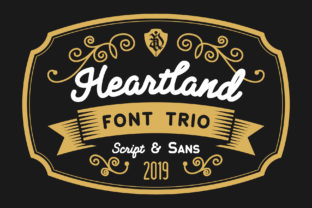
Heartland Trio: Vintage Charm Meets Modern Design Flexibility
Designers today face a constant balancing act: honoring timeless aesthetics while meeting the functional demands of digital interfaces, branding systems, and responsive layouts. That’s where Heartland Trio stands out—not as a nostalgic relic, but as a thoughtfully crafted typographic toolkit built for real-world use. At its core, Heartland Trio is a retro-inspired font family composed of three distinct yet harmonious styles: a confident bold script and two complementary rounded sans-serif weights. Together, they form a cohesive system that evokes mid-century Americana without sacrificing clarity, legibility, or versatility.
A Script That Speaks With Confidence—Not Clutter
The standout of the trio is its bold script—a deliberate departure from delicate, ornamental handwriting fonts. This isn’t a whisper; it’s a warm, assured voice. Its letterforms feature generous spacing, open counters, and subtle bounce—giving it rhythm without sacrificing readability at scale. Unlike many script fonts that collapse into illegibility below 36pt, Heartland’s script holds up remarkably well even at 24pt in print or on high-DPI screens.
What makes it especially practical? It avoids excessive ligatures and unpredictable alternates. You won’t spend hours hunting for the “right” lowercase g or troubleshooting inconsistent word spacing. Instead, it delivers consistent, friendly energy—ideal for logotypes, packaging headers, café menus, or social media banners where personality matters but professionalism can’t be compromised.
Two Rounded Sans Styles: Function Meets Friendly
Where many script-heavy families falter is in supporting text. Heartland Trio solves that with two purpose-built rounded sans-serifs: one medium-weight and one light. Both share the same x-height, cap-height, and proportional rhythm as the script—ensuring visual harmony whether used side-by-side or across different touchpoints.
- The medium weight excels in UI components, product labels, and short-form web copy—offering just enough presence to guide attention without competing with the script.
- The light weight shines in captions, footnotes, ingredient lists, or minimalist brand guidelines—its airiness creates contrast and breathing room without fading into invisibility.
Crucially, both sans styles include full Latin character sets, standard punctuation, numerals with tabular and proportional options, and OpenType features like true small caps and stylistic sets. They’re not afterthoughts—they’re engineered to carry weight (literally and figuratively) in complex design systems.
Why “Retro-Inspired” Doesn’t Mean “Stuck in the Past”
Retro typography often carries baggage: limited language support, poor hinting on screens, or rigid licensing that blocks web use. Heartland Trio was designed with contemporary constraints in mind. It renders cleanly across browsers, supports variable font axes (where applicable), and includes WOFF2 files optimized for fast loading. Whether you’re building a Shopify store for a vintage record label or designing an email campaign for a craft brewery, the fonts load quickly and behave predictably.
Its retro feel comes not from imitation—but from thoughtful reinterpretation. The rounded terminals nod to 1950s signage. The generous letter-spacing echoes hand-painted diner menus. But the underlying metrics, spacing logic, and kerning pairs follow modern typographic standards. That means your headline won’t look charmingly dated in Safari and awkwardly cramped in Chrome.
Where Heartland Trio Fits Naturally—and Where It Doesn’t
Some fonts try to be everything. Heartland Trio knows its strengths—and its boundaries. It thrives in contexts where warmth, approachability, and tactile authenticity matter:
- Food & beverage branding: Think artisanal coffee roasters, local bakeries, or small-batch soda labels—where the script adds handmade charm and the sans provides clean, scannable ingredient info.
- Local business identity: A neighborhood florist, independent bookstore, or boutique hotel benefits from Heartland’s human-scale proportions and inviting tone.
- Editorial design with personality: Zines, indie magazines, or seasonal lookbooks gain cohesion when headlines and body text share DNA—even if they’re stylistically distinct.
- Digital products with soul: Onboarding flows, dashboard welcome messages, or app onboarding screens gain friendliness without veering into childishness.
It’s less suited for corporate annual reports, technical documentation, or enterprise SaaS dashboards where neutrality and extreme scalability are non-negotiable. That’s not a flaw—it’s focus. Choosing Heartland Trio signals intention: you want your audience to feel welcomed, not briefed.
Pairing Smartly—Beyond the Obvious
Because Heartland Trio includes three coordinated styles, pairing becomes intuitive—not a guessing game. Still, smart usage unlocks its full potential:
- Lead with contrast, not competition: Use the bold script only for primary hierarchy—logos, H1s, or hero text. Let the medium sans handle subheads and buttons, and the light sans manage body copy or fine print.
- Respect vertical rhythm: When stacking script + sans (e.g., a logo lockup), align baselines—not caps. The script’s slight ascender/descender variation works best when given space to breathe above and below the sans.
- Embrace restraint in color: Heartland’s warmth shines in muted palettes—think olive, terracotta, cream, or slate blue. Avoid neon accents unless irony is part of your brand voice; the fonts carry enough personality on their own.
And yes—you *can* pair Heartland Trio with external typefaces, but do so sparingly. A single neutral serif (like Merriweather or Lora) works beautifully for long-form blog content alongside Heartland’s sans body text. Just avoid other rounded or script fonts—they’ll muddy the voice instead of amplifying it.
Licensing, Workflow, and Real-World Adoption
Heartland Trio ships with clear, straightforward licensing—covering desktop, web, app, and even basic merchandise use (like tote bags or mugs). No per-page fees. No surprise audits. For agencies, that predictability saves time on legal review and budgeting. For solo designers or small studios, it removes friction between inspiration and implementation.
In practice, teams integrate it smoothly: import the variable OTF into Figma or Adobe Fonts, activate web versions via CSS @font-face, and sync across platforms using shared style guides. Kerning adjustments are rarely needed—the family ships with tight, tested defaults. And because all three fonts share the same Unicode coverage and diacritic support, multilingual projects (e.g., English/Spanish bakery signage) stay consistent without workarounds.
One quiet advantage? Its file size. The entire trio compresses to under 350KB—lighter than many single-display fonts. That matters for performance scores, Core Web Vitals, and users on slower connections. Vintage shouldn’t mean sluggish.
Final Thought: Typography as Tone-Setting Tool
At its best, typography doesn’t just communicate words—it communicates mood, values, and unspoken promises. Heartland Trio delivers that with unusual consistency. It says “we care about craft” without shouting. It suggests “this is made by people, for people” without leaning on clichés. And it does all this while working reliably—across devices, languages, and production pipelines.
If your next project calls for sincerity over slickness, warmth over sterility, or charm with structure—Heartland Trio isn’t just an option. It’s a quietly powerful choice that bridges eras without pretending either one is obsolete.