Seamless Pattern Frames: Elevate Your Designs with Versatile Dingbat Fonts
What Are Seamless Pattern Frames?
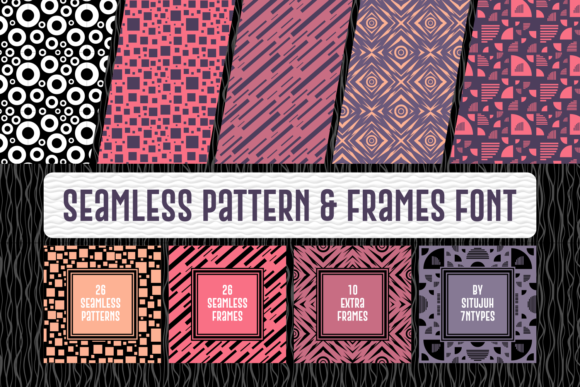
Seamless pattern frames are a specialized category of dingbat fonts—typefaces composed not of letters or numbers, but of decorative glyphs such as borders, corners, tiles, and repeatable motifs. Unlike standard fonts, these are designed to tile infinitely without visible seams, making them ideal for creating consistent, professional-looking backgrounds, dividers, badges, and framing elements in digital and print design.
Think of them as “design building blocks”: each glyph is crafted to align perfectly with adjacent characters, whether you're typing a row of interlocking circles, a border made of minimalist arrows, or a subtle grid of squares. Because they’re delivered as OpenType or TrueType fonts, they install like any other font—and work natively in Adobe Creative Cloud apps, Figma, Canva, Affinity Designer, and even Microsoft PowerPoint or Google Slides.
Why Seamless Patterns Matter in Modern Design
In today’s fast-paced creative landscape, efficiency and visual cohesion are non-negotiable. Designers—from social media managers crafting Instagram carousels to educators building engaging lesson slides—need tools that deliver polish without complexity. Seamless pattern frames bridge that gap.
They eliminate the need to manually copy-paste vector shapes or wrestle with alignment grids. Instead, you type a single character (e.g., “A” for a corner motif or “-” for a horizontal divider), then extend it across your canvas with predictable, pixel-perfect repetition. This saves time, reduces errors, and ensures brand consistency—especially when applying recurring visual language across websites, presentations, or packaging.
Real-World Use Cases You’ll Recognize
- Social Media Graphics: Frame quote posts with elegant floral borders or geometric line patterns—no clipping masks or layering required.
- Presentation Slides: Add subtle corner accents to title pages or use arrow motifs to guide viewers’ attention between sections.
- Printed Materials: Create custom dividers for newsletters, elegant section headers in annual reports, or repeating background textures on business cards.
- Web & UI Design: Generate lightweight, scalable SVG-like borders using CSS
@font-faceand Unicode characters—ideal for performance-conscious developers. - Educational Resources: Teachers use circle-based patterns to build visual schedules or behavior charts; students apply square grids for mind maps or study trackers.
From Squares to Abstract: A Pattern Palette for Every Purpose
The strength of seamless pattern frames lies in their intentional diversity. Rather than offering one “style,” top-tier collections include thoughtfully curated families—each serving distinct functional and aesthetic needs.
Squares & Grids: Structure and Clarity
Square-based patterns provide rhythm and order. They’re ideal for data visualization overlays, modular layouts, or minimalist dividers. A 4×4 dot grid glyph, for example, can become a subtle background texture behind text—enhancing readability without distraction.
Circles & Dots: Softness and Flow
Circular motifs introduce warmth and continuity. Think concentric rings for focus areas, dotted lines for gentle transitions, or scalloped edges for playful branding. These patterns naturally draw the eye inward—making them perfect for spotlighting key messages or product features.
Arrows & Directional Elements: Guidance and Motion
Arrows aren’t just for navigation menus. As seamless dingbats, they transform into dynamic visual cues—pointing left/right to indicate swipeable content, forming circular progress indicators, or lining up as step-by-step process markers. Their directional clarity supports accessibility and user comprehension.
Abstract & Organic Patterns: Expressive Uniqueness
Abstract frames—featuring fluid lines, asymmetrical tessellations, or hand-drawn-inspired repeats—add personality without chaos. They’re especially valuable for brands seeking differentiation in saturated markets (e.g., wellness startups, indie publishers, or boutique studios). Because they’re font-based, they scale flawlessly at any size—unlike rasterized textures that blur or pixelate.
Debunking Common Misconceptions
Many designers assume seamless pattern frames are “just for hobbyists” or “too niche for professional work.” That couldn’t be further from the truth.
Misconception #1: “They’re outdated because we have vector libraries.”
While vector assets offer flexibility, they require manual placement, grouping, and resizing. Seamless fonts automate repetition—and remain fully editable: change color with one click, adjust spacing via tracking, or flip orientation using CSS transforms.
Misconception #2: “Only graphic designers benefit.”
Not true. Content creators, HR professionals designing onboarding kits, marketers building email templates, and even developers embedding decorative UI elements all leverage these fonts daily. Their low learning curve makes them accessible—even if you’ve never opened Illustrator.
Misconception #3: “All pattern fonts are equal.”
Quality varies widely. Truly seamless fonts undergo rigorous testing: glyphs must align precisely at all common sizes (12pt–72pt+), support OpenType features like contextual alternates, and include comprehensive Unicode coverage (including dedicated slots for corners, edges, and fills). Always preview before purchasing—or download reputable free trials.
How to Get Started—No Design Degree Required
Integrating seamless pattern frames into your workflow takes minutes:
- Download & Install: Choose a trusted source (look for clear licensing—personal vs. commercial use matters).
- Open Your App: Launch Canva, Photoshop, or PowerPoint—then select the new font from your type menu.
- Type & Repeat: Use the character map or included PDF guide to identify glyphs (e.g., “Q” = top-left corner, “W” = top edge, “E” = fill tile).
- Refine & Export: Adjust letter spacing (tracking) to tighten or loosen repeats. Export as PDF or PNG—retaining full vector fidelity where supported.
Pro tip: Pair pattern frames with sans-serif body text for maximum contrast and legibility. And remember—subtlety often wins. A 10% opacity geometric border adds sophistication without competing for attention.
Looking Ahead: Patterns in the Age of AI & Automation
As generative AI reshapes design workflows, seamless pattern fonts remain uniquely human-centered. While AI tools can suggest layouts or generate textures, they rarely understand the precise typographic logic needed for infinite tiling, responsive scaling, or cross-platform rendering. That’s why designers continue to rely on carefully engineered dingbat fonts—not as relics, but as intelligent, interoperable tools.
Moreover, sustainability is emerging as a quiet advantage: pattern fonts are tiny file sizes (often under 100KB), reducing bandwidth use and carbon footprint compared to high-res image-based alternatives. In an era where ethical design includes environmental awareness, that’s meaningful.
Final Thought: Design Is Communication—Patterns Are Its Punctuation
Just as commas, em dashes, and quotation marks shape meaning in writing, seamless pattern frames shape meaning in visual communication. They signal hierarchy, imply movement, evoke mood, and reinforce identity—all without a single word.
Whether you’re framing a student’s science fair poster or refining a Fortune 500 investor deck, these fonts offer more than decoration. They offer intentionality. Clarity. Craft.
So next time you reach for a border or background, ask yourself: Could this be simpler, sharper, and more scalable? If the answer is yes—you already know where to look.